Calcium is defined as the most abundant mineral in the human body, and its role in nutritional shakes goes far beyond bone support. Calcium drives muscle contraction, supports nerve signaling, and accelerates post-workout recovery. Yet most people assume any protein shake delivers meaningful calcium. That assumption is wrong. The actual calcium content of a shake depends entirely on its ingredients. Sources like calcium caseinate, ultra-filtered dairy milk, and fortified plant milks each deliver calcium differently. Choosing the right base determines whether your shake genuinely supports bone density and muscle repair or simply tastes good.
How does calcium support muscle recovery and function in nutritional shakes?
Calcium is the trigger for muscle contraction. Every time a muscle fiber fires, calcium ions flood the cell and initiate the contraction sequence. Without adequate calcium, that process stalls, and recovery slows.

Protein shakes that include calcium do more than refuel muscles. They support the full recovery cycle. Calcium plus protein work together to rebuild muscle fibers and maintain bone density after resistance training. That synergy is why calcium-rich protein shakes outperform plain protein powders mixed with water.
Calcium caseinate is the standout ingredient for sustained recovery. It is a milk-derived protein that releases amino acids slowly over several hours. That slow release makes it ideal for overnight muscle repair and prolonged satiety between meals. Whey protein absorbs fast and spikes amino acid levels quickly. Calcium caseinate fills the gap by maintaining elevated amino acid levels for longer.
Key reasons calcium matters in recovery shakes:
-
Muscle contraction: Calcium ions trigger every muscle fiber activation during and after exercise.
-
Nerve signaling: Calcium carries signals between nerves and muscles, keeping coordination sharp during training.
-
Bone remodeling: Resistance training stresses bone tissue. Calcium from shakes supports the remodeling process that makes bones denser.
-
Sustained amino acid delivery: Calcium caseinate provides a slow drip of amino acids, supporting repair while you sleep.
-
Protein absorption: Calcium improves the environment for protein digestion, making each gram of protein more effective.
Pro Tip: If you train in the evening, choose a shake built on calcium caseinate rather than whey. The slow digestion profile supports overnight repair far better than a fast-absorbing protein.
What are the best calcium sources used in nutritional shakes?
Not all calcium sources perform equally in a shake. The ingredient you choose affects calcium content, digestibility, texture, and overall nutrition.
Calcium caseinate is the most functional calcium source in commercial protein shakes. It acts as a stabilizer and thickener, giving shakes a creamy texture while delivering bioavailable calcium. It prevents separation and improves mouthfeel, which is why many premium protein powders list it as a primary ingredient. Its nutritional and textural benefits make it a dual-purpose ingredient that earns its place in any serious shake formula.
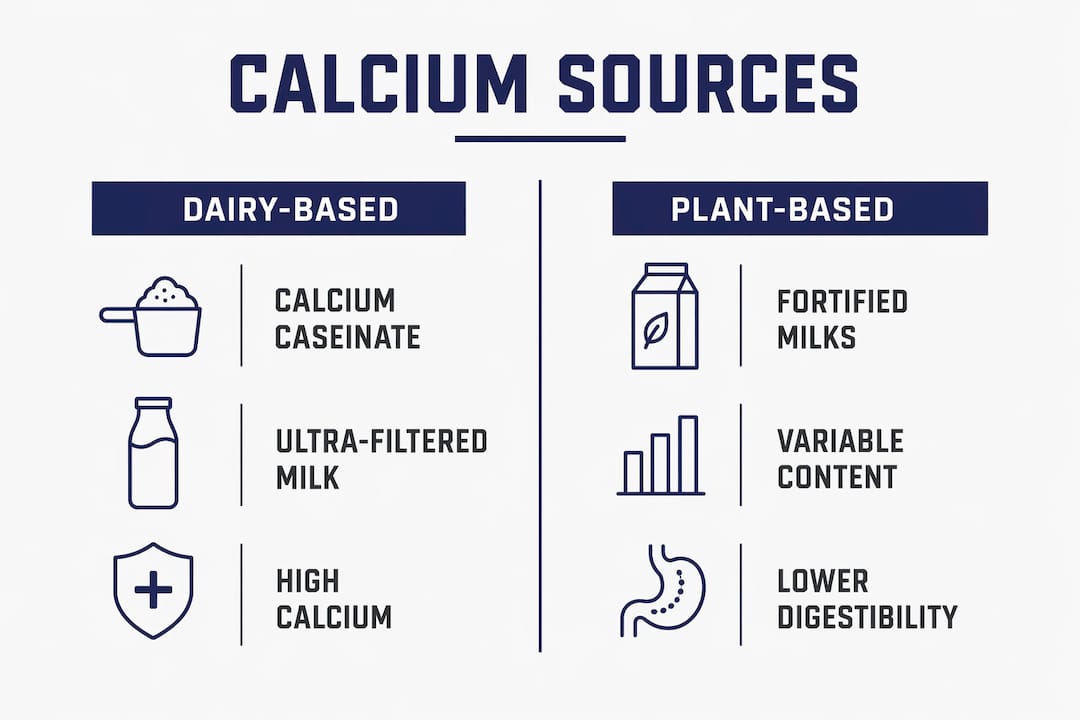
Ultra-filtered dairy milk is the second major source. Ultra-filtration concentrates naturally occurring calcium and protein while filtering out sugars and lactose. The result is a milk-based shake with higher calcium and protein per serving than traditional milk. Fairlife, for example, uses ultra-filtered milk to achieve calcium levels that standard dairy cannot match.
Fortified plant-based milks like almond, oat, and soy milk can deliver meaningful calcium when manufacturers add calcium carbonate or calcium phosphate. The key word is “fortified.” Unfortified plant milks contain very little calcium. Always check the label before assuming a plant-based shake base contributes to your daily intake.
| Calcium source |
Calcium content |
Digestibility |
Key benefit |
| Calcium caseinate |
High |
Slow |
Sustained amino acid release, texture |
| Ultra-filtered dairy milk |
Very high |
Moderate |
Concentrated minerals, low sugar |
| Standard dairy milk |
Moderate |
Moderate |
Widely available, balanced nutrition |
| Fortified plant milk |
Moderate (varies) |
Fast |
Dairy-free, lactose-free option |
| Unfortified plant milk |
Very low |
Fast |
Not a reliable calcium source |
The table makes one point clear. Unfortified plant milks are not a calcium source. Choosing them as your shake base without fortification means you are building a shake that is nutritionally thin on calcium, regardless of what else you add.
How to optimize calcium absorption when consuming nutritional shakes
Getting calcium into a shake is only half the job. Your body must actually absorb it. Several factors determine how much of that calcium reaches your bones and muscles.
Vitamin D is the most critical co-factor. Without sufficient Vitamin D, your intestines cannot absorb calcium efficiently. High-quality fortified shakes include Vitamin D for exactly this reason. If your shake does not list Vitamin D on the label, your calcium absorption may be suboptimal regardless of how much calcium the formula contains.
Pairing calcium with protein amplifies the benefit. Protein stimulates the production of insulin-like growth factor, which supports bone formation and calcium retention. A shake that combines calcium caseinate with a high-calcium dairy base delivers both nutrients together, which is more effective than taking them separately.
Practical steps to build a high-calcium shake:
-
Start with a high-calcium base. Use dairy milk, ultra-filtered milk, or fortified plant milk instead of water. Water-based fruit blends are nutritionally sparse and contribute almost no calcium.
-
Add Greek yogurt. One cup of Greek yogurt adds roughly 200 mg of calcium and boosts protein content simultaneously.
-
Include seeds. Chia seeds and sesame seeds are concentrated plant-based calcium sources that blend well into shakes.
-
Add leafy greens. Kale and spinach contribute calcium alongside iron and magnesium, supporting a broader mineral profile.
-
Check for Vitamin D. Verify that your protein powder or fortified milk includes Vitamin D to maximize calcium uptake.
Pro Tip: Read the Supplement Facts panel on every protein powder you buy. Look for calcium listed as a percentage of Daily Value and confirm Vitamin D is present. A shake with 30% Daily Value of calcium but no Vitamin D delivers far less benefit than the label implies.
How much calcium is in popular nutritional shakes and homemade recipes?
Calcium content varies widely across shake types. Knowing the numbers helps you plan your daily intake against the recommended 1,000 mg per day for most adults.
Commercial dairy-based protein shakes lead the field. Certain high-performance options provide up to 900 mg of calcium per serving, which is roughly 70% of the daily recommended intake in a single bottle. That concentration is possible because ultra-filtration technology removes sugars and lactose while retaining and concentrating minerals. Standard dairy-based shakes deliver less, but still contribute meaningfully to daily targets.
Homemade shakes tell a different story. A banana milkshake made with one glass of toned milk contains 200–250 mg of calcium. That is a solid contribution, but it covers only 20–25% of the daily target. Adding Greek yogurt or a calcium-fortified protein powder to that same recipe can push the total well above 400 mg per serving.
| Shake type |
Calcium per serving |
% Daily Value |
| Ultra-filtered dairy protein shake |
Up to 900 mg |
~70% |
| Standard dairy-based protein shake |
300–400 mg |
30–40% |
| Homemade banana milkshake (toned milk) |
200–250 mg |
20–25% |
| Fortified plant-based protein shake |
200–350 mg |
20–35% |
| Water-based fruit smoothie |
Under 50 mg |
Under 5% |
The gap between a water-based smoothie and an ultra-filtered dairy shake is striking. Ingredient and formulation choices determine whether a shake delivers meaningful calcium or almost none. The base ingredient is the single biggest lever you control.
Key takeaways
Calcium in nutritional shakes delivers real bone and muscle benefits only when the shake is built on high-calcium ingredients like ultra-filtered dairy milk or calcium caseinate.
| Point |
Details |
| Calcium drives muscle contraction |
Every muscle fiber activation depends on calcium ions, making it non-negotiable for recovery shakes. |
| Calcium caseinate is dual-purpose |
It delivers slow-release amino acids and acts as a texture stabilizer, making it the top ingredient for sustained recovery. |
| Ultra-filtered milk maximizes calcium |
Ultra-filtration concentrates calcium to levels that standard dairy cannot match, reaching up to 900 mg per serving. |
| Vitamin D unlocks absorption |
Calcium without Vitamin D is poorly absorbed; always verify both are present in your shake formula. |
| Base ingredient determines outcome |
Water-based smoothies contribute under 50 mg of calcium. Dairy or fortified plant milk bases deliver 10 to 18 times more. |
Why I think most people are getting calcium wrong in their shakes
Most fitness-focused people track protein obsessively and ignore calcium completely. I understand why. Protein is the headline nutrient in every shake marketing campaign. But calcium is the nutrient that makes protein work better for your bones and muscles.
What I have observed consistently is that people build shakes with water and a protein powder, then wonder why their recovery feels incomplete. The protein is there. The calcium is not. Calcium caseinate’s slow digestion profile is genuinely superior for endurance recovery and overnight muscle maintenance. Yet most people have never heard of it because it is not marketed as aggressively as whey.
The other mistake I see is treating plant-based shakes as automatically healthy and calcium-rich. They are not, unless they are built on fortified bases. An unfortified almond milk shake with fruit is essentially a low-calcium dessert. That is fine occasionally, but it should not be your recovery shake.
My practical advice is this: treat calcium as a primary nutrient in your shake, not an afterthought. Choose your base first based on calcium content. Then add protein. That shift in thinking changes the nutritional outcome of every shake you make. Combined with consistent resistance training and a balanced diet, calcium-rich shakes become a genuine tool for long-term bone and muscle health, not just a post-workout habit.
— Just
Protein products from Justmovesupplements that support calcium-rich shakes
Justmovesupplements makes it straightforward to build shakes that actually deliver on calcium and protein together.
The Plain and Simple Unflavored Protein is a clean, versatile base that pairs with any high-calcium liquid, from ultra-filtered dairy milk to fortified plant milk, without competing flavors getting in the way. It is the kind of product that lets your ingredients do the work. For those who want a guided approach to building high-calcium, protein-rich shakes, the Protein Shake Recipes PDF from Justmovesupplements gives you tested recipes that take the guesswork out of ingredient selection. Both products reflect Justmovesupplements’ commitment to quality nutrition that supports real performance and recovery goals.
FAQ
What is the role of calcium in nutritional shakes?
Calcium in nutritional shakes supports muscle contraction, bone remodeling, and nerve signaling. It works alongside protein to improve post-workout recovery and long-term bone density.
Does calcium caseinate improve muscle recovery?
Calcium caseinate releases amino acids slowly over several hours, making it superior for overnight muscle repair compared to fast-absorbing proteins like whey.
How much calcium should a good protein shake contain?
A high-quality protein shake should contribute at least 20–30% of the daily recommended calcium intake per serving. Ultra-filtered dairy-based shakes can deliver up to 900 mg, or roughly 70% of the daily target.
Why does Vitamin D matter in calcium-rich shakes?
Vitamin D is required for efficient intestinal absorption of calcium. Without it, much of the calcium in a shake passes through without being absorbed by the body.
Are plant-based shakes good sources of calcium?
Fortified plant-based shakes can deliver 200–350 mg of calcium per serving. Unfortified versions contribute very little calcium and should not be relied on as a primary calcium source.
Recommended
Article generated by BabyLoveGrowth


