A caloric deficit means eating fewer calories than your body burns in a day, which forces it to pull energy from stored fat to make up the difference. Most clinicians point to a daily deficit of about 300 to 500 calories as the sweet spot for safe, sustainable weight loss, producing roughly 1 to 2 pounds of loss per week without triggering the muscle loss and metabolic slowdown that come with more extreme cuts.
That’s the short version. If you’re ready to act on it, the smartest first move isn’t cutting calories tonight. It’s spending 7 to 10 days tracking what you currently eat, so you know your real starting point instead of guessing.
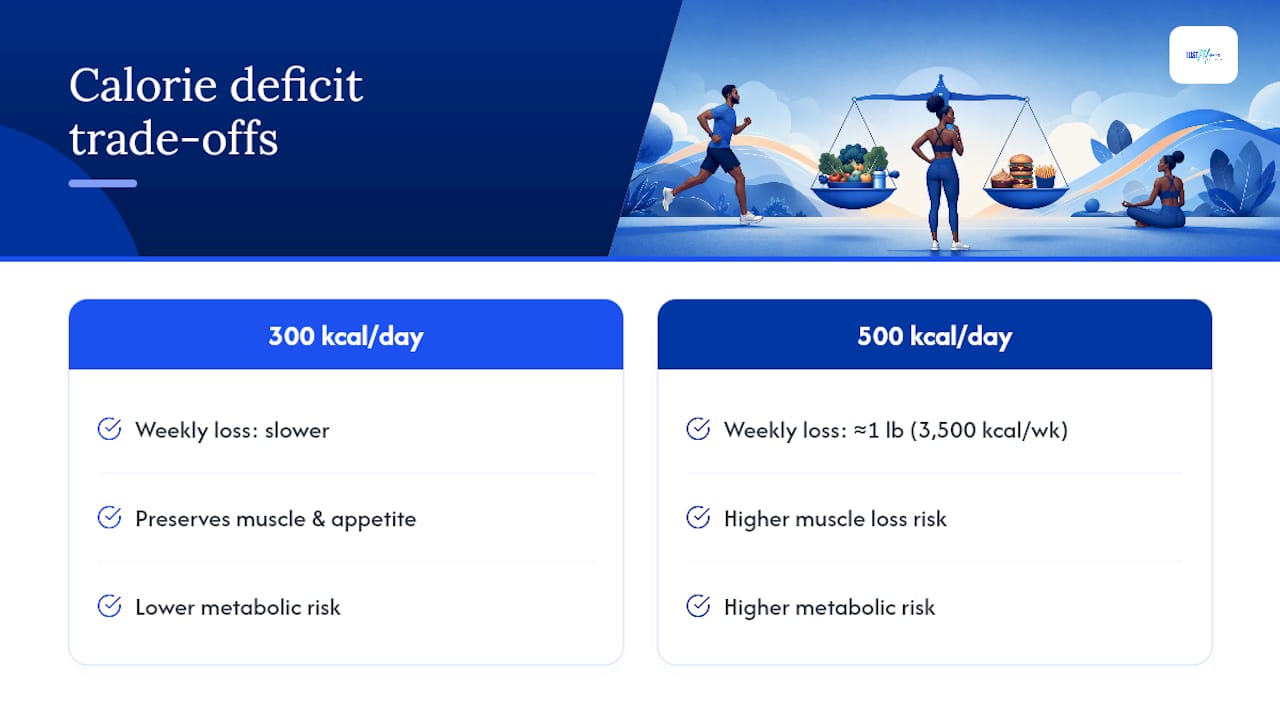
Quick numbers to anchor on: a 500-calorie daily deficit adds up to about 3,500 calories a week, which roughly equals one pound of fat loss. Go smaller (300 calories) and you’ll lose slower but keep more muscle and hunger in check. Go much bigger, and you’re gambling with both.
Key Takeaways
A caloric deficit of 300 to 500 calories a day, paired with adequate protein and resistance training, produces safe, sustainable fat loss while protecting muscle and metabolism.
| Point |
Details |
| Definition stays simple |
A calorie deficit means eating fewer calories than your body burns in a day. |
| Target a moderate deficit |
Aim for 300 to 500 calories daily for roughly 1 to 2 pounds of weekly loss. |
| Protein and lifting are non-negotiable |
Hit 0.7 to 1 gram of protein per pound of body weight and train with resistance twice weekly. |
| Track before you cut |
Log intake for 7 to 10 days first to set an accurate, personalized baseline. |
| Look past the scale |
Use measurements, strength performance, and photos to confirm real fat loss. |
| Supplements support, don’t replace |
Products like Justmovesupplements’ protein packs and Just Shred can help hit protein and appetite goals as adjuncts to solid habits. |
Table of Contents
What Is Caloric Deficit, and Why Does It Cause Weight Loss?
Your body needs energy to keep your heart beating, your lungs breathing, and your cells repairing themselves, even when you’re doing nothing but lying in bed. That baseline energy cost is your resting metabolic rate, and it does more work than most people realize.
Total daily energy expenditure (TDEE) breaks down into three main pieces:
-
Resting metabolic rate (RMR): the calories burned just to keep you alive, typically 60% to 70% of your total daily burn.
-
Thermic effect of food (TEF): the energy your body spends digesting, absorbing, and processing what you eat, usually around 10% of intake.
-
Activity energy expenditure: everything from formal workouts to fidgeting and walking to your car, often called NEAT (non-exercise activity thermogenesis) when it’s outside structured exercise.
When you eat less than that combined total, your body has to find energy somewhere else. It taps stored fat first, and if the deficit is steep or prolonged enough, it starts breaking down muscle tissue too, which is exactly what you don’t want.
Here’s the part most weight-loss advice skips: your body doesn’t sit still and let you win. Drop your calories and stick with it for a few weeks, and you’ll likely see metabolic adaptation. Your resting metabolic rate can dip lower than your body weight alone would predict, your hunger hormones ramp up, and your NEAT quietly drops. You fidget less, take the elevator instead of the stairs, and don’t even notice it happening.
Pro Tip: Weigh yourself weekly, not daily, and look at the trend line, not the single number. Water retention from sodium, hormones, or a hard workout can swing your weight up to a few pounds day to day, which has nothing to do with fat loss.
Diet changes still tend to move the needle faster than exercise on energy intake, but exercise stays essential for a different reason: protecting your lean mass and keeping your metabolism from working against you.

How Do You Calculate a Caloric Deficit?
Getting your numbers right takes three steps: estimate your resting burn, scale it up for activity, and subtract your target deficit.
-
Calculate your BMR (basal metabolic rate). The Mifflin-St Jeor equation is the formula most dietitians and clinicians default to because it’s held up well against measured energy expenditure in research. It factors in your weight, height, age, and sex.
-
Multiply by an activity factor to get your TDEE. This converts your resting number into your true daily burn, accounting for how much you move.
-
Subtract your target deficit. Pick a number between 300 and 500 calories and subtract it from your TDEE. That’s your new daily target.
Here’s the math in action. Say a 35-year-old woman weighing 165 pounds, 5’6" tall, calculates a BMR of roughly 1,450 calories using Mifflin-St Jeor. She works a desk job but walks her dog daily and hits the gym three times a week, putting her in the “lightly active” category.
Applying the 1.375 multiplier: 1,450 x 1.375 = 1,994 calories, her estimated TDEE. Subtract a 450-calorie deficit, and her daily target lands at roughly 1,544 calories, putting her on track for close to a pound of loss per week.
You don’t have to do this math by hand every time. The NIH Body Weight Planner models how changes in intake and activity play out over weeks and months, and it’s a genuinely useful second check against your manual calculation.
How Big Should Your Calorie Deficit Be?
The evidence is fairly consistent here, which is refreshing in a space full of conflicting advice. A 300 to 500 calorie daily deficit is the range clinicians most often recommend, translating to a weight-loss pace of about 1 to 2 pounds per week.
-
Stay conservative if muscle retention matters to you. A smaller deficit (closer to 300 calories) preserves more lean tissue and keeps hunger more manageable over months, not just weeks.
-
Avoid deficits larger than 1,000 calories without supervision. Extreme cuts accelerate muscle loss, tank your resting metabolic rate, and often backfire through rebound overeating.
-
Watch for warning signs your deficit is too aggressive. Persistent fatigue, trouble concentrating, irritability, disrupted sleep, and a sudden drop in workout performance all signal you’ve cut too hard, too fast.
Pro Tip: If you’re losing more than 2 pounds a week for several weeks running, don’t assume it’s all fat. A meaningful chunk is probably water and muscle, especially if your protein intake and resistance training aren’t dialed in.
Certain groups need a conversation with a healthcare provider before starting any deficit at all: pregnant or breastfeeding women, anyone with a history of disordered eating, people managing diabetes or thyroid conditions, and anyone already at a low body weight. This article offers general information, not personalized medical advice. If you fall into one of these categories, or you’re unsure whether a deficit is appropriate for your situation, talk to a doctor or registered dietitian before changing your intake.
What’s the Best Way to Actually Create a Deficit?
Cutting calories doesn’t have to mean eating less food. It usually means eating smarter food.
-
Eat for volume, not just calories. Vegetables, broth-based soups, and high-water-content foods fill you up on fewer calories than energy-dense options like fried food or refined carbs.
-
Cut liquid calories first. Sodas, juices, sweetened coffee drinks, and alcohol add up fast and rarely make you feel full, making them the easiest target for a quick win.
-
Prioritize protein at every meal. Protein has the highest thermic effect of the three macronutrients and does more for satiety per calorie than fat or carbs, which makes hitting your target easier to sustain. A high-protein meal replacement can help here on busy days.
-
Increase your NEAT. Park farther away, take walking meetings, use stairs instead of elevators. These small movements add up to real calories over a week.
-
Keep resistance training in the mix, at least twice weekly. Lifting signals your body to hold onto muscle even while you’re eating less, which protects your resting metabolic rate long term.
Practitioners generally advise adding good habits before stripping away entire food groups: build in more protein and vegetables first, then trim the extras. It’s a mindset shift that makes the whole process feel less like punishment.
Small, consistent changes beat dramatic overhauls almost every time. A dietitian’s advice on eating in a deficit repeatedly comes back to one theme: sustainability wins because it’s the only approach people actually stick with long enough to see results.
If you’re testing out meal ideas that fit a lower-calorie budget without feeling restrictive, resources like healthy eating strategies for travel and everyday meals offer practical, high-volume meal frameworks worth borrowing.
Why Am I Not Losing Weight in a Calorie Deficit?
You’ve done the math, you’re eating less, and the scale isn’t budging. Before you assume your metabolism is broken, check these common culprits.
-
Inaccurate tracking. Eyeballing portions, forgetting the cooking oil, and skipping the coffee creamer in your log can hide 200 to 400 calories a day without you noticing.
-
Overestimated exercise burn. Fitness trackers and gym machines routinely overstate calories burned, sometimes by a wide margin, leading people to eat back more than they actually earned.
-
A deficit that’s stopped being a deficit. As you lose weight, your TDEE drops too. The 500-calorie deficit you calculated at 180 pounds isn’t the same deficit once you hit 165.
-
Not enough protein or strength training. Muscle loss slows your metabolism, so skipping resistance training while cutting calories can undercut your own progress.
-
Relying only on the scale. Water retention from sodium, stress, sleep, or your menstrual cycle can mask real fat loss for days or weeks at a time.
Before overhauling your whole plan, track your intake accurately for 7 to 14 days using a food scale where possible, then adjust your calories down slowly rather than slashing them further. Review your sleep and stress levels too. Poor sleep raises hunger hormones and can stall progress even when your calorie math is technically correct.
Certain symptoms deserve medical attention rather than another round of self-troubleshooting: rapid, unexplained weight change in either direction, extreme fatigue that doesn’t improve with rest, or any signs of disordered eating patterns like obsessive tracking or fear around food.
How Long Should You Stay in a Deficit?
Most people can sustain a moderate deficit for 8 to 12 weeks before their body and mind start asking for a break. Stalling weight, persistent hunger, dropping workout performance, and mood changes are all signs it’s time to pause, not push harder.
Transitioning back to maintenance isn’t a single jump. Recalculate your TDEE as your weight drops (remember, a lighter body burns fewer calories), then increase your intake gradually, adding back 100 to 200 calories per week while watching your body composition and energy levels rather than just the scale.
Some people benefit from a structured diet break: a planned one to two week return to maintenance calories partway through a longer cut. It can reset hunger hormones and improve adherence for the next phase. This isn’t for everyone, though. If you have a history of disordered eating or struggle with all-or-nothing thinking around food, a diet break can trigger a spiral back into old patterns, and it’s worth discussing with a professional first.
How Do You Preserve Muscle During a Calorie Deficit?
Losing weight and losing fat are not the same goal, even though they get treated that way constantly. The real target is losing fat while keeping as much muscle as possible, and the science on how to do that is fairly clear.
-
Hit a protein target in the range of 0.7 to 1 gram per pound of body weight daily. This is higher than general population guidelines but supported by research on preserving lean mass during calorie restriction.
-
Spread protein across 3 to 4 meals rather than front or back-loading it. Your body can only use so much protein for muscle repair at once, so distribution matters as much as total intake.
-
Train with resistance at least twice weekly, progressing the load over time. Controlled studies show resistance training substantially reduces lean-mass loss compared to dieting without strength work.
| Monitoring method |
What it tells you |
How often to check |
| Body measurements (waist, hips, arms) |
Fat loss even when scale weight stalls |
Every 2 weeks |
| Strength performance in the gym |
Whether you’re preserving or losing muscle |
Every session |
| Progress photos |
Visual changes scale numbers miss |
Every 2 to 4 weeks |
| Weekly weight trend average |
True direction, filtered from water fluctuation |
Weekly |
A protein-focused meal replacement or well-timed shake can make it much easier to hit these numbers on days when whole-food meal prep isn’t realistic. What actually protects your muscle is the combination of enough protein and enough training stimulus, not either one alone.
What I Want You to Take Away From All This
The biggest misconception about a caloric deficit isn’t about the math. It’s the assumption that more restriction always equals more results. In reality, the people who keep the weight off long term are almost never the ones who cut hardest. They’re the ones who found a deficit small enough to live with for months, kept lifting weights the whole time, and paid attention to more than just a number on a scale.
Patience is the unglamorous ingredient nobody wants to hear about, but it’s the one that actually works. If you have a medical condition, a history of disordered eating, or you’re pregnant or breastfeeding, loop in a clinician before you start. Everyone else, watch your strength numbers and how your clothes fit as closely as you watch the scale. Those signals tell you the truth faster than daily weigh-ins ever will.
Where Supplements Fit Into a Calorie Deficit
Diet and training do the heavy lifting in any calorie deficit, but hitting your protein target every single day through whole food alone is genuinely hard when life gets busy. That’s the gap Justmovesupplements is built to close, not to replace the fundamentals, but to make the fundamentals easier to hit consistently.

If protein intake is your weak link, the protein sample pack lets you find flavors you’ll actually finish instead of a tub of powder you dread scooping. And if appetite management during a deficit has been your sticking point, Just Shred - Green Apple Fat Burner is formulated as an adjunct to support energy and appetite control alongside solid nutrition and training, not a substitute for either. Browse the full fat burner collection if you want to compare options before you commit. Start with the sample pack if you’re still dialing in your protein routine, or check the Just Shred product page for ingredient details if appetite control is your priority.
Sources
This article provides general information and isn’t a substitute for personalized medical advice. Talk to a doctor or registered dietitian before starting a calorie deficit if you have an underlying health condition or a history of disordered eating.
Recommended


