Protein flavor masking is defined as the application of specialized compounds and technologies to block or neutralize bitter, earthy, chalky, and metallic off-notes in protein supplements. These off-notes appear in both plant and whey proteins, and 33% of North Americans now prioritize high protein content in the products they buy. That demand creates a real problem: higher protein concentrations intensify unpleasant flavors, making taste a genuine barrier to consistent use. Flavor masking solves that problem by working at the sensory and biochemical level, using bitter blockers, sweetness enhancers, and emulsified fats to suppress off-notes without compromising nutrition. The industry term for this practice is “flavor modulation,” and understanding it helps you choose protein products that actually taste good.
What is protein flavor masking and why does it matter?
Protein flavor masking is the science of making high-protein supplements palatable by reducing the sensory signals that make them taste unpleasant. Masking agents act as “flavor fixers,” preserving the nutritional profile while delivering a cleaner taste experience. They do not simply cover up bad flavors. They interrupt the biochemical pathway that tells your brain something tastes wrong.
The practical stakes are high. Formulations with 15–30g of protein per serving face the most intense off-note challenges. Without masking, virtually every high-protein product would require excessive sweeteners or artificial flavors to be drinkable. Masking technology removes that trade-off, letting formulators keep the label clean while keeping the product enjoyable.

What kinds of off-flavors do protein supplements have and why?
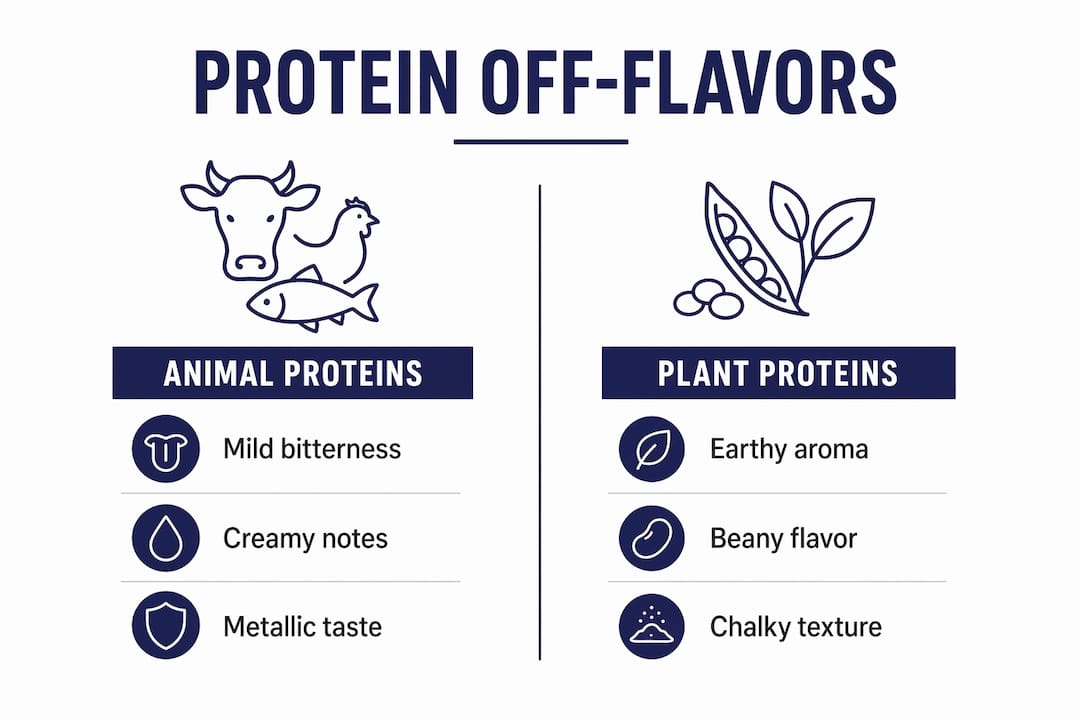
Protein supplements carry a predictable set of off-notes, and each one has a specific biochemical cause. Knowing the source of each off-note explains why generic flavor fixes rarely work.
Common off-notes found in protein supplements include:
-
Bitterness: Caused by short-chain peptides released during protein hydrolysis and by polyphenols in plant sources like pea and soy.
-
Earthiness and beany notes: Produced by secondary metabolites in legume-based proteins, particularly lipoxygenase activity in soy.
-
Chalkiness: Linked to protein precipitation near the isoelectric point (pH 4.5–5.0), where proteins clump and create a dry, powdery mouthfeel.
-
Metallic notes: Often traced to mineral content and lipid oxidation byproducts such as hexanal, which form during processing and storage.
-
Astringency: Results from protein-polyphenol interactions that bind to saliva proteins and create a drying sensation.
Plant proteins present the most complex flavor challenges. Pea, soy, and chickpea proteins each carry distinct off-note signatures driven by their unique phytochemical compositions. Whey proteins are generally milder, but they still develop metallic and sour notes when processed at high temperatures or stored improperly.
Processing conditions and ingredient purification affect flavor more than protein concentration alone. Mineral concentration and filtration methods determine how many off-note precursors reach the final product. Starting with a cleaner protein base reduces the masking burden downstream, which is why ingredient quality and formulation skill work together.
How does protein flavor masking work?
Protein flavor enhancement techniques operate through three primary mechanisms, each targeting a different stage of sensory perception. Together, they create a product that tastes clean without relying on sugar or artificial flavoring.
-
Bitter blockers (GPCR antagonists). These compounds bind to the same G-protein-coupled receptors (GPCRs) on your taste buds that bitterness activates. By occupying those receptor sites, they prevent bitter peptides from triggering an unpleasant signal. The result is a measurably reduced perception of bitterness, not just a masked one.
-
Sweetness enhancers for cross-modal suppression. Sweetness and bitterness compete at the sensory level. Ingredients like monk fruit extracts and steviol glycosides amplify sweet perception, which neurologically suppresses bitter signals. Monk fruit and steviol glycoside mixtures disrupt bitterness perception at concentrations of approximately 0.1%–1.5%, supporting the main flavor without overshadowing it.
-
Emulsified fats for hydrophobic entrapment. Many off-note compounds are hydrophobic, meaning they bind to fat rather than water. Emulsified fats trap these compounds and delay their interaction with taste receptors. pH adjustment away from the isoelectric point (4.5–5.0) works alongside emulsified fats to reduce protein precipitation and improve mouthfeel simultaneously.
Masking vs. neutralizing: what is the difference?
Masking and neutralizing are distinct approaches. Masking distracts sensory perception by interrupting the signal pathway. Neutralizing physically alters or blocks the offending compound’s interaction with taste buds for a longer-term effect. Formulators differentiate these two approaches because the choice affects both the ingredient list and the shelf-life stability of the product.
Common masking ingredients
Vanillin, sweet cream flavoring, monk fruit extracts, and steviol glycosides are the most widely used masking agents in protein formulations. Each acts as a supporting actor rather than a dominant flavor. Flavor masking modulates nerve signals so that off-notes do not register as unpleasant, preserving the original nutritional and flavor profile of the protein base.
Pro Tip: Start bench-top testing at 0.1% masking compound concentration and increase gradually to 1.5%. Exceeding that range often introduces new off-notes rather than eliminating existing ones.
How does flavor masking improve real protein products?
The practical applications of protein flavor enhancement techniques span every major product format. Understanding where masking shows up helps you evaluate what you are buying.
-
Protein powders: Masking agents reduce the chalky, beany aftertaste in plant-based powders, making them mixable and pleasant without added sugar.
-
Ready-to-drink (RTD) shakes: Emulsified fats and bitter blockers are critical here because liquid formats amplify off-notes compared to dry powder.
-
Protein bars: Sweetness enhancers suppress the bitterness that intensifies during baking, where heat accelerates the Maillard reaction and creates new off-note compounds.
-
Functional beverages: Masking allows formulators to hit 20g+ protein per serving without the metallic aftertaste that typically accompanies high mineral loads.
Flavor masking enables cleaner label claims by reducing the need for excessive sweeteners or artificial flavors. That matters to athletes and health-conscious consumers who read ingredient lists carefully. A product with fewer additives and a better taste profile is a direct result of effective masking technology.
Plant-based proteins benefit most visibly. Pea and soy proteins carry strong earthy and beany notes that historically made them difficult to use at high concentrations. Masking agents now allow these proteins to more closely mimic the mild, creamy flavor profile of dairy-based whey. That shift has made plant-based protein options viable for athletes who previously avoided them on taste grounds alone.
Neuroscience-driven masking represents the next stage of this field. Researchers are mapping the specific receptor pathways activated by each off-note compound, allowing formulators to design targeted blockers with greater precision. The result is a sensory experience that feels natural rather than engineered.
Common misconceptions about masking protein off-flavors
The most widespread mistake in protein formulation is adding more characterizing flavors or sugar to fix off-notes. Over-layering flavors creates cluttered profiles that fail sensory panels and taste artificial to consumers. More chocolate flavoring does not fix a bitter pea protein. It creates a product that tastes like bitter chocolate.
Specialized masking compounds work precisely because they leave no flavor signature of their own. They fix the problem at the receptor level rather than burying it under competing tastes. Masking is a neuroscience discipline focused on flavor fixing, not flavor covering. That distinction changes how formulators approach the entire development process.
The order of ingredient addition also matters more than most people realize. Adding masking agents to the protein base before introducing characterizing flavors prevents muddy or chemical aftertastes. Adding masking agents first gives them time to bind to off-note compounds before the main flavor system is introduced, producing a cleaner final profile.
Custom masking systems outperform generic solutions. A masking blend designed for pea protein will not perform the same way on whey or soy, because each protein source carries a different off-note signature. Matching the masking system to the protein source is the single most effective step a formulator can take.
Pro Tip: Avoid formulating at pH 4.5–5.0. That range triggers protein precipitation and chalkiness, which no masking agent can fully correct after the fact. Adjust pH first, then apply masking compounds.
Key Takeaways
Protein flavor masking is the most direct method for improving protein supplement palatability without sacrificing nutritional integrity or adding excessive sweeteners.
| Point |
Details |
| Masking works at the receptor level |
Bitter blockers and sweetness enhancers interrupt sensory signals before your brain registers an off-note. |
| Three core mechanisms drive results |
Bitter blockers, sweetness enhancers, and emulsified fats each target a different stage of off-note perception. |
| Dosage precision is critical |
Test masking compounds at 0.1%–1.5% concentration to avoid introducing new off-notes. |
| Order of addition affects outcome |
Add masking agents to the protein base before characterizing flavors to prevent chemical aftertastes. |
| Plant proteins benefit most |
Pea, soy, and chickpea proteins carry the strongest off-notes and gain the most from targeted masking systems. |
Why flavor masking is the future of protein nutrition
I have watched the protein supplement category evolve for years, and the shift toward science-backed flavor masking is the most meaningful change I have seen. For a long time, the industry defaulted to sugar and artificial flavoring to make high-protein products drinkable. That approach worked commercially, but it compromised the clean-label promise that serious athletes and health-conscious consumers actually want.
What excites me now is the convergence of neuroscience and food science. Researchers are identifying the exact receptor pathways that each off-note activates, which means masking systems are becoming more targeted and more effective with each product cycle. The days of a one-size-fits-all vanilla flavor covering up a chalky pea protein are ending. What replaces them is a formulation approach that respects both the science and the consumer.
My honest advice: look for products that list specific masking-related ingredients like monk fruit extract, steviol glycosides, or sweet cream flavoring rather than products that simply pile on sugar or sucralose. Those ingredient choices signal that a brand invested in real flavor science rather than a quick fix. The taste difference is real, and so is the nutritional difference.
— Just
Justmovesupplements and the science of better-tasting protein
Justmovesupplements builds every protein formulation with taste and nutrition working together, not against each other. The brand applies proven flavor modulation principles to deliver protein products that are genuinely enjoyable, whether you prefer a bold flavor or a clean, neutral base.
The Plain and Simple Unflavored Protein is a direct example of masking technology at work: a clean protein base with off-notes controlled at the formulation level, giving you full flexibility to use it in shakes, recipes, or baked goods. If you want to explore flavored options before committing to a full tub, the protein sample variety pack lets you taste seven different profiles and find what works best for your palate and your goals.
FAQ
What is protein flavor masking in simple terms?
Protein flavor masking is the use of specialized compounds to block or reduce bitter, chalky, and metallic off-notes in protein supplements. It works at the taste receptor level rather than simply adding more flavoring on top.
Why do plant proteins taste worse than whey?
Plant proteins like pea, soy, and chickpea contain secondary metabolites and polyphenols that produce strong earthy, beany, and bitter notes. Whey proteins are milder by comparison, though they still develop metallic and sour notes under heat or poor storage conditions.
Does flavor masking affect the nutritional content of protein?
Flavor masking does not reduce protein content or alter macronutrient values. Masking agents are used at very low concentrations (0.1%–1.5%) and target sensory perception, not the protein structure itself.
What ingredients are used to mask protein flavor?
Common masking agents include vanillin, sweet cream flavoring, monk fruit extracts, and steviol glycosides. Each works by suppressing specific off-note signals at the taste receptor level without adding a dominant flavor of its own.
Is adding more sugar an effective way to improve protein taste?
Adding more sugar or characterizing flavors alone does not fix protein off-notes. Over-layering creates cluttered flavor profiles that taste artificial and still fail sensory evaluation panels.
Recommended


