Yes, protein before bed works, but only under specific conditions: it needs to pair with evening resistance training and fit inside adequate total daily protein, not replace it. A 30 to 45 gram dose taken roughly 30 minutes before sleep raises overnight muscle protein synthesis and, over 12 weeks, translates into measurable strength and size gains. The evidence comes from randomized controlled trials and tracer studies, not guesswork.
TL;DR:
- Doses of 30 to 45 grams of protein taken 30 minutes before sleep consistently boost overnight muscle protein synthesis and lead to measurable strength and size gains over 12 weeks.
- Consuming pre-sleep protein increases both mitochondrial and myofibrillar synthesis, supporting endurance and muscle building, especially when paired with resistance training.
- Total daily protein intake should be adequate and not replaced by nighttime protein; the prime benefit occurs when it adds to an already sufficient daily intake.
- The type of protein, whether casein or whey, matters less than dose consistency, with both providing similar anabolic effects at doses around 45 grams.
- Practical intake methods include concentrated shakes, Greek yogurt, cottage cheese, or protein pudding, ideally consumed about 30 minutes before sleep to improve recovery without disturbing sleep.
Table of Contents
What the Research Shows About Protein Before Bed
The strongest piece of evidence for pre-sleep protein comes from a 12-week randomized controlled trial in young, healthy men doing resistance training. Participants who consumed protein nightly before sleep gained more strength and packed on more quadriceps cross-sectional area than a placebo group performing identical training. That’s not a marginal difference. It’s roughly double the muscle growth over three months, in subjects who were already training hard.
A newer, more mechanistic study fills in the “why.” Researchers gave endurance athletes 45 grams of protein 30 minutes before sleep and tracked overnight synthesis rates using tracer methodology. The 2023 randomized controlled trial found both mitochondrial synthesis (0.087 ±0.020 vs 0.067 ±0.016%·h⁻¹) and myofibrillar synthesis rose significantly compared to placebo. Mitochondrial synthesis matters for endurance adaptation and metabolic capacity; myofibrillar synthesis is the literal building of contractile muscle tissue. Getting both to increase overnight, from a single bedtime dose, is a meaningful signal that the body doesn’t just idle during sleep.
Here’s the mechanism connecting these two studies: eating protein before bed keeps plasma amino acids elevated through the night. Normally, an overnight fast drops circulating amino acids and shifts the body toward net protein breakdown. A pre-sleep dose reverses that, and a 2019 Frontiers review confirmed that protein consumed before sleep is digested and absorbed normally overnight, feeding that elevated amino acid pool for hours rather than getting “wasted” by inactivity.
What the data actually confirms:
- Nightly pre-sleep protein over 12 weeks increased strength and muscle cross-sectional area versus placebo in trained young men.
- A single 45 gram dose raised both mitochondrial and myofibrillar protein synthesis overnight in a controlled tracer study.
- Digestion and amino acid absorption continue normally during sleep, according to the Frontiers review.
- Studies using lower protein doses sometimes showed inconsistent or absent effects.
The numbers that matter most: in the 12-week trial, the protein group’s quadriceps cross-sectional area grew nearly double what the placebo group achieved, an effect size large enough to matter for anyone chasing hypertrophy over a training block.
None of this means timing is magic on its own. A review of protein distribution and timing points out that pre-sleep protein often works because it’s an easy window to hit a higher total daily protein intake, not because midnight is some special anabolic hour. If you’re already eating enough protein spread across the day, the pre-sleep dose is additive insurance, not a separate lever.
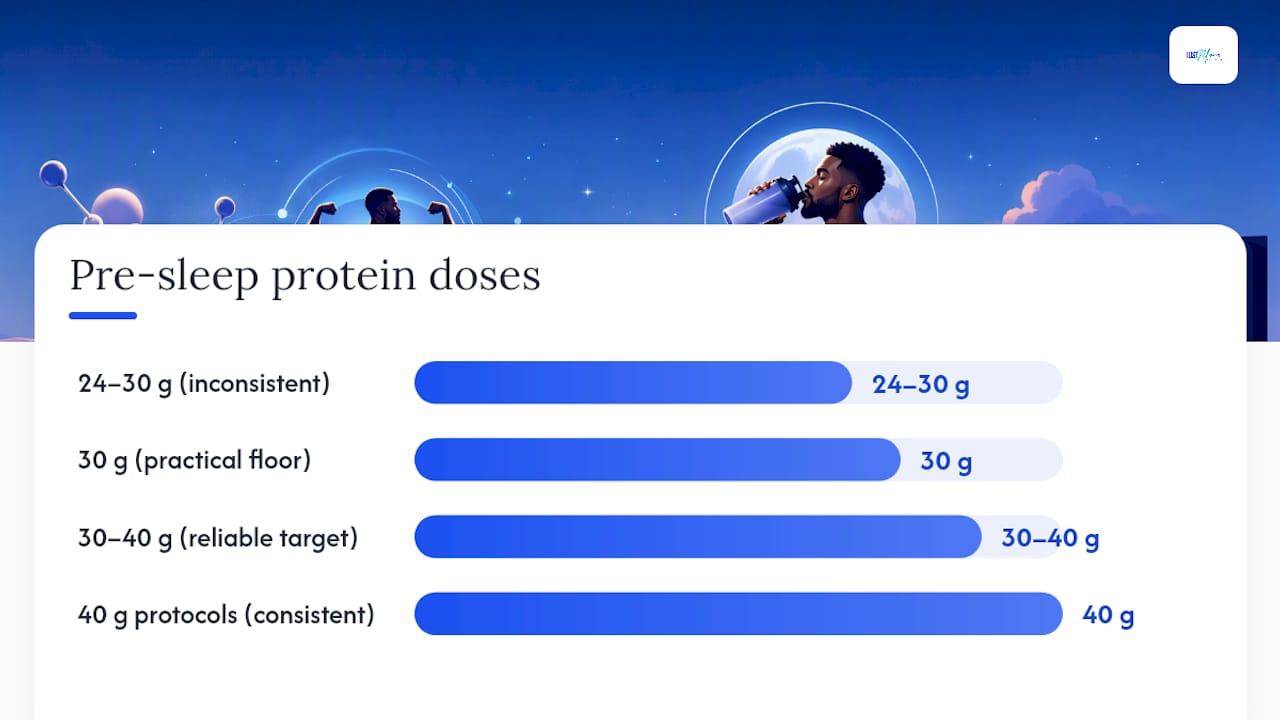
The limitations are worth naming plainly. Most of the strongest trials used young, trained men, so the size of the effect in untrained beginners, women, or older lifters isn’t fully mapped. Dose response wasn’t perfectly linear either. Some studies with lower doses (24 to 30 grams) found no measurable benefit, while 30 to 45 gram doses consistently showed effects, suggesting a threshold exists somewhere in that range rather than a smooth curve. And because most trial designs paired the protein with a structured resistance program, it’s genuinely hard to separate how much credit belongs to the bedtime timing versus the simple fact that participants were eating more total protein and training consistently.
How Much Protein and When You Should Take It
Across the trials, the most reliable effects occur with doses around 30 to 40 grams; lower doses showed less consistent benefits. A review update on pre-sleep protein notes that studies using 24 to 30 grams sometimes showed no measurable benefit, while the 40-gram protocols used in several trials consistently produced positive outcomes. If your goal is an actual overnight anabolic response rather than just topping off your day, treat 30 grams as your practical floor.
Timing matters less than people assume, but it isn’t arbitrary. Most trials had subjects consume their dose roughly half an hour before sleep. That window gives digestion a head start, so amino acids are already entering circulation as you fall asleep rather than sitting in an empty stomach. Chugging a shake and immediately lying down doesn’t sabotage the effect, but the 30-minute buffer is what the research protocols actually used, so it’s the safest bet to replicate.
One warning that’s easy to overlook: pre-sleep protein should be additive, not a replacement for the protein you’re already eating during the day. Swapping your evening snack for a protein shake while skipping other meals defeats the purpose. The goal is to add 30 to 40 grams on top of a day that already meets your baseline needs, which for most lifting athletes falls somewhere between 1.6 and 2.2 grams per kilogram of bodyweight.
Practical ways to hit that dose without a giant glass of water sloshing in your stomach before bed:
- A concentrated shake made with a low-carb, high-protein powder mixed into a small volume of milk or water.
- Greek yogurt stirred with a scoop of protein powder for a thicker, spoon-eaten option.
- Cottage cheese, which naturally contains a high proportion of casein and digests slowly on its own.
- A protein pudding made by thickening powder with a small amount of liquid and letting it set in the fridge.
Pro Tip: If you’re a light sleeper who wakes up to use the bathroom, cut your fluid volume, not your protein grams. A thick pudding or yogurt bowl delivers the same 35 grams as a shake in a third of the liquid.
Casein vs. Whey: Which Protein Works Best at Night
For years, casein was treated as the default nighttime protein, and the reasoning made sense on paper. Micellar casein clots in the stomach and releases amino acids slowly over several hours, which sounds like a perfect match for an eight-hour fast. That’s why “slow digesting protein powder” and “extended release protein” became shorthand for casein specifically in gym culture.
The newer tracer data complicates that story. In the 2023 randomized controlled trial comparing whey and casein at matched 45 gram doses before sleep, researchers found no significant difference in mitochondrial or myofibrillar synthesis between the two. Whey digests faster, but at that dose and timing, it still elevated overnight amino acid availability enough to match casein’s slower release. That challenges the automatic assumption that casein is required for a bedtime protein strategy to work.
What this means practically: total dose and consistency matter more than protein type for most lifters. If casein sits better with your stomach or you simply prefer the thicker texture, use it. If whey is what’s in your pantry, or you tolerate it better, the tracer evidence says you’re not leaving gains on the table by skipping casein specifically.
For readers avoiding dairy or managing lactose intolerance, plant-based blends (pea, soy, or rice protein combinations) can reach comparable amino acid profiles when combined, though single-source plant proteins tend to run lower in leucine, the amino acid most tied to triggering synthesis. Blended plant proteins or a slightly higher total dose can close that gap.
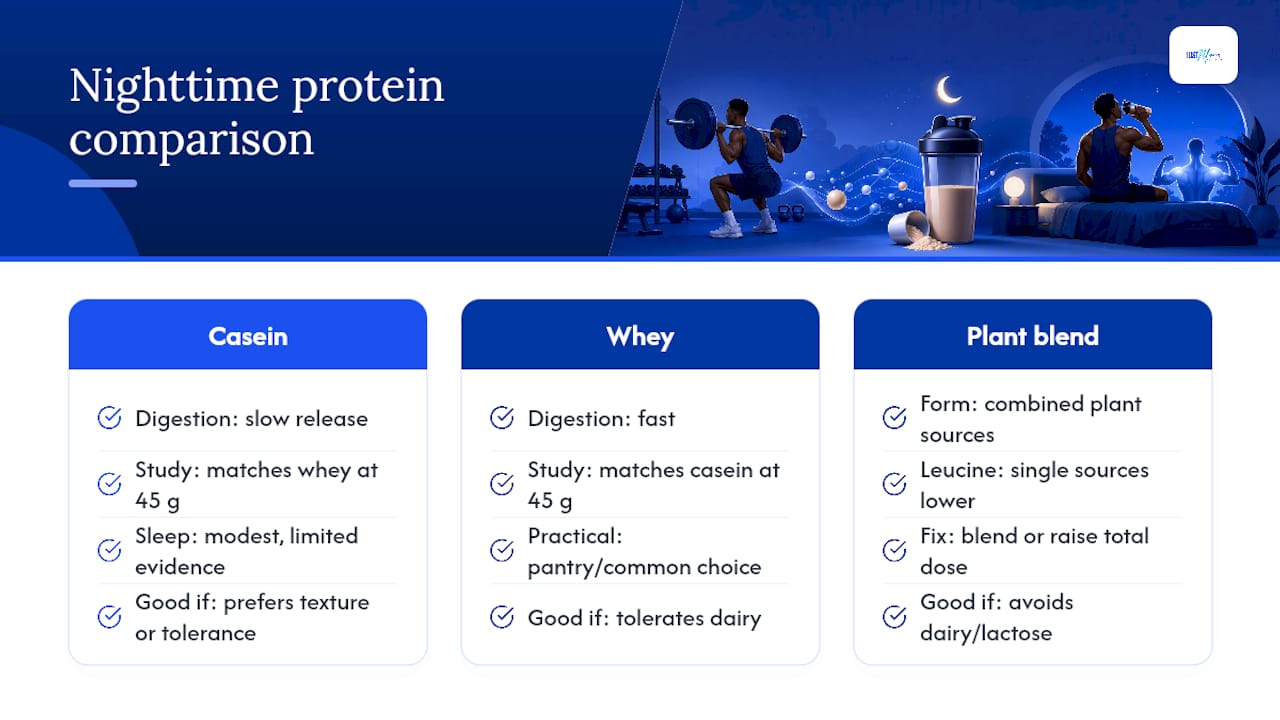
A few smaller studies have also looked at casein’s effect on subjective sleep quality itself, not just muscle synthesis. Coverage of this research on Sleep notes modest improvements in sleep latency and efficiency in small trials, though the evidence base here is thin and shouldn’t be oversold. Choose your protein type based on your gut tolerance, your flavor preference, and what you’ll actually consume consistently. That consistency will do more for your results than agonizing over casein versus whey.
Who Benefits Most From a Bedtime Protein Dose
-
Evening lifters get the biggest lift. The Frontiers review describes an additive effect when resistance training happens in the hours before bed: the workout primes muscle tissue to actually use the overnight amino acids, rather than the dose sitting on top of an untrained system. If your hardest training session is at 6 or 7 p.m., a bedtime protein dose is doing real work.
-
Endurance athletes coming off evening sessions. The tracer study’s mitochondrial synthesis findings suggest pre-sleep protein isn’t purely a bodybuilder’s tool. Runners, cyclists, and rowers finishing hard evening sessions may get a metabolic recovery benefit alongside any muscular one.
-
Older adults and clinical populations, with a caveat. A research update on skeletal muscle adaptation notes that older adults often show anabolic resistance, meaning they need higher protein doses or activity paired with feeding to get the same synthetic response younger lifters get from a smaller dose. Pre-sleep protein alone, without activity, is a weaker lever in this group.
-
Anyone chronically under their daily protein target. If you’re missing your daily protein goal by 20 to 30 grams most days, a bedtime dose is often the easiest meal of the day to add, according to protein timing research.
Skip it, or scale it back, if a shake before bed disrupts your sleep, causes GI discomfort, or pushes your calories past your goals. There’s no version of this strategy worth a bad night’s sleep.
Low-Volume Nighttime Protein Options That Won’t Wreck Your Sleep
Hitting 30 to 40 grams without a bloated stomach or three trips to the bathroom takes a little planning. The trick is concentration: more protein per ounce of liquid, not more liquid overall.
A concentrated shake using Plain And Simple unflavored protein mixed into just 150 to 250 milliliters of milk or water delivers a full 35 to 40 gram dose without the volume of a typical daytime shake. Because it’s unflavored, it also blends cleanly into yogurt or oats without fighting other flavors.
For a food-based route, stir a scoop of powder into Greek yogurt or cottage cheese for a thick, spoon-eaten snack that digests slowly on its own. High-protein overnight oats, prepped the night before in a jar, are another low-effort option worth building into a weekly routine. Justmovesupplements has a step-by-step overnight oats recipe that layers oats with protein powder for a grab-and-eat breakfast that doubles as prep for tomorrow’s dose.
For sensitive sleepers, thicker is better than thinner. A protein pudding, made by whisking powder into a small amount of liquid and letting it set, delivers the same grams in far less fluid than a shake, cutting the odds of a middle-of-the-night bathroom trip. High-sugar snacks before bed are worth avoiding too, since blood sugar swings can interfere with sleep quality independent of the protein itself.
If you want more portable, food-first inspiration beyond powders, Wild Foodz’s guide to eating well while traveling has practical ideas for high-protein snacks that travel well, several of which adapt easily into a bedtime routine.
How Just Move Supplements Fits Your Nightly Protein Routine
Hitting 30 to 40 grams before bed is simple when your protein powder is built for it. Plain And Simple unflavored protein mixes into a small volume of liquid without adding sweetness you don’t want right before sleep, making it the cleanest option for a concentrated bedtime shake. If you’d rather have something dessert-like, Banana Pudding Protein and Chocolate Cake Protein both thicken well into pudding-style snacks that hit the same gram targets.
Not sure which flavor fits your routine? The Just Move Protein Sample Variety Pack lets you test seven flavors before committing to a full tub, which matters when you’re trying to build a habit you’ll actually stick with every night.
For lifters running an evening fat-loss phase, Sleep N Shred and the AM/PM Shred Bundle are worth pairing with your protein routine as complementary nighttime support, not as a substitute for the dose itself. And if you’re building out a full recovery framework, Justmovesupplements’ guide on why recovery nutrition timing matters breaks down how timing and total intake work together.
Testing Pre-Sleep Protein in Your Own Training Block
The honest way to know if pre-sleep protein is doing anything for you is to run it like a small experiment, not a permanent habit adopted on faith. Pick a 2 to 4 week block that lines up with evening resistance training, since that’s the scenario the strongest trials actually tested. Add 30 to 40 grams of protein about 30 minutes before sleep on training days, and track a few simple markers: perceived soreness the next morning, how ready you feel to train (your session RPE), sleep quality, and bodyweight trend over the block.
What surprises most people is how boring the “success” signal actually looks. You’re not chasing a dramatic overnight transformation. You’re looking for slightly faster recovery between sessions and steadier strength progression over weeks, which is exactly what the 12-week trial measured. If you don’t notice any of that after a full month, or if the shake is genuinely disrupting your sleep or pushing your calories somewhere you don’t want them, drop it without guilt. It’s a tool, not a requirement. For a more structured way to test it against a full training cycle, Justmovesupplements’ recovery nutrition plan walks through how to layer timing changes without losing track of what’s actually working.
— Just
Ready to Try a Bedtime Protein Routine Tonight
If you’ve read this far, you already know the two numbers that matter: 30 to 40 grams, about 30 minutes before sleep. The easiest way to hit that dose without overhauling your kitchen is starting with Plain And Simple unflavored protein, which mixes clean into a small glass of milk or water and won’t leave you fighting extra sweetness right before bed.

If you’re not sure which flavor profile you’ll actually enjoy eating every night for a month, the Just Move Protein Sample Variety Pack gives you seven flavors to test in smaller portions first, so you’re not stuck with a full tub you end up avoiding. For a concentrated bedtime shake, mix one scoop into 150 to 200 milliliters of milk or water, stir well, and drink it about half an hour before you turn the lights off. Grab a sample pack or head to the protein samples collection to build your first week of nightly doses.
Sources
Recommended


