Neither format wins outright. Shakes usually deliver more protein per calorie, while bars deliver more chewing satisfaction and portability. If you’re refueling after a hard session, a shake mixed in a Just Move 20 oz. Shaker Cup gets protein into your body fast. If you need something to hold you over between meetings, a bar wins on staying power.
TL;DR:
Choosing a protein shake over a bar is preferable immediately after a workout due to faster digestion, but a bar can be better for long stretches between meals.
The protein content per calorie and ingredient quality, not the format, determines whether a product truly supports your nutritional goals.
Reading the full nutrition label is essential to avoid high sugar alcohols, unhealthy fats, and hidden sugars, which can negate the benefits.
Total daily protein intake is the key driver of muscle gain, with timing and format having minimal impact beyond convenience.
Substituting a protein source for an unhealthier snack supports weight management, but consuming additional protein without tracking overall calories does not promote fat loss.
Justmovesupplements
Find Protein That Fits Your Routine
Explore varied protein options and nutritional supplements designed for fitness enthusiasts who value taste, effectiveness, and everyday convenience.
Protein Bar or Shake: Why Both Deserve a Spot in Your Routine
Before picking sides, give credit where it’s due. Both formats exist to solve the same basic problem: getting enough protein into your day without cooking a chicken breast in the office microwave. When you pair either one with resistance training, you’re supporting the same muscle repair process your body needs after a workout.
The overlap between a protein bar and a protein shake is bigger than most product marketing admits.
Both help you hit daily protein targets without meal prep, which matters most on busy training days.
Both can replace snacks or drinks that offer little more than sugar and empty calories, like a vending machine cookie or a sweetened latte.
Both support muscle repair when your training is consistent, since protein alone doesn’t build anything without the resistance work behind it.
Both can backfire if you pick the wrong version, since a “protein” label doesn’t guarantee a smart nutritional choice.
That last point deserves attention. A bar loaded with chocolate coating and corn syrup solids isn’t meaningfully different from a candy bar with a marketing budget. A shake made with flavored syrups and low-quality fillers can carry more sugar than the soda it’s supposedly replacing. The format isn’t the problem or the solution. The formulation is. Registered dietitians who work with athletes tend to make this same point: a bar that keeps you from grabbing a vending machine snack is doing its job, and a shake that replaces a sugary drink or helps you hit a protein target on a cutting phase can be the smarter pick for weight loss, depending entirely on what’s actually in it.
That’s why the real comparison isn’t bar versus shake. It’s good formulation versus bad formulation, wrapped in whichever packaging happens to be more convenient for your day.
Bar or Shake: Satiety, Composition, and Practicality Compared
The differences that actually matter show up in three places: how full you feel afterward, what’s in the ingredient list, and how the product fits into your actual life.
Satiety is where solids tend to pull ahead. A trial comparing solid and liquid meal replacements of similar calorie content found that solid meal replacements reduced hunger more than liquid versions over a four-hour window, with different insulin and ghrelin responses between the two forms. Chewing signals fullness to your brain in a way that sipping doesn’t always replicate, even when the calorie counts match exactly.
Composition tends to run in opposite directions. Bars often carry more fat, more carbohydrate, and more total ingredients to hold their shape and texture, think oils, binders, and coatings. A shake mixed with water rather than milk or juice can pack more protein per calorie, since you’re not adding extra fat or sugar from a mixer.
Practicality is where lifestyle decides the winner. Bars need zero prep, no water, no shaker, and no refrigeration in most cases. Shakes need a container and a liquid source, but they digest faster and work better immediately after a workout when solid food feels unappealing.
Here’s how those three factors typically play out in real situations:
Post-workout, still catching your breath: a shake wins, since a liquid protein source is easier to get down when your appetite hasn’t returned yet.
Mid-afternoon hunger at your desk: a bar wins, since the chewing and fiber content buy you more time before the next hunger signal hits.
Travel day with no access to a fridge or blender: a bar wins on pure logistics.
Trying to stay under a tight calorie target: a shake often wins, since you control the exact liquid volume and avoid the fat and sugar that thicken most bar recipes.
Watch the ingredient list on bars specifically for sugar alcohols like maltitol or erythritol, which draw water into the gut and can cause bloating or looser stools in sensitive people. Coatings and “protein crisps” are frequent sources of hidden sugar and low-quality fat that don’t show up in the headline protein number.
Pro Tip:If a bar leaves you bloated, check the ingredient list for anything ending in “-ol” before blaming the protein itself. Sugar alcohols are the usual culprit, not the whey or plant protein source.
How to Read a Protein Bar or Shake Label Correctly
The label comparison only works if you compare the right numbers. A scoop of powder sitting in a bag isn’t a serving. It becomes one once you add water or milk, and that finished mixture is what you should stack against a bar’s packaged nutrition panel.
Four numbers matter more than the “high protein” banner on the front of the package:
Protein-to-calorie ratio. Divide grams of protein by total calories. A shake at 25 grams of protein for 130 calories beats a bar at 20 grams of protein for 220 calories, even though the bar’s front label looks more impressive.
Added sugars and sugar alcohols. The Nutrition Facts panel separates added sugars from naturally occurring ones, and sugar alcohols show up in the ingredient list, not always the sugar line.
Fiber and saturated fat. Fiber helps satiety, while saturated fat quietly inflates a bar’s calorie count without adding protein.
Sodium. Bars formulated for shelf stability often carry more sodium than a simple shake mixed at home.
The FDA’s dietary supplement labeling guidance sets specific rules for what terms like “low calorie” can legally mean on a supplement label, but “high protein” isn’t strictly defined the same way for every product category. A bar can call itself high protein at 10 grams if the rest of the panel technically qualifies, which is why the ratio matters more than the marketing claim. Reading past the front of the package is the only reliable way to compare a protein shake against whole food meals or against a bar sitting next to it on the shelf.
Cost matters too, and it’s a simple calculation. Take the price of the product and divide it by grams of protein per serving. A $2.50 bar with 20 grams of protein costs $0.125 per gram. A $40 tub of powder yielding 30 servings at 25 grams each costs roughly $0.053 per gram. Shakes usually win this math by a wide margin, which is worth knowing before assuming bars are the “convenient and cheap” option by default.
What the Research Actually Says About Protein Timing and Format
Here’s the finding that surprises most people: the format you choose and the exact minute you consume it matter far less than how much protein you eat across the entire day.
A 2022 systematic review and meta-analysis found that total daily protein intake combined with resistance training drives strength and fat-free mass gains, with supplementation showing the strongest benefit up to roughly 1.6 grams per kilogram of body weight per day. Beyond that intake, additional protein produces diminishing returns rather than proportional muscle gain. A separate large-scale analysis covering 49 studies and more than 1,800 participants confirmed the same plateau near 1.6 g/kg/day, reinforcing that this isn’t a one-off result.
Timing gets even less credit than most fitness content suggests. A systematic review focused specifically on protein ingestion timing found that consuming protein before versus after a workout generally does not meaningfully change lean body mass outcomes. The “30-minute anabolic window” that supplement marketing loves to reference has far less scientific backing than the emphasis it gets.
What that means practically:
A 180-pound lifter (about 82 kg) targeting 1.6 g/kg/day needs roughly 131 grams of protein spread across the day, not crammed into a single post-workout shake.
Whether that protein arrives as a shake at 5:45 PM or a bar at 6:15 PM barely moves the needle, as long as the daily total lands in range.
Consistency across weeks beats precision within any single hour. A shake’s advantage is genuinely about convenience and easier reach of your daily number, not some metabolic timing trick.
If you’re chasing muscle gain or faster recovery, stop treating the clock like it’s the variable that matters. Treat your daily total like it is, because research consistently points there as the real driver.
Using Bars and Shakes to Manage Weight Without Overeating
Weight management is where format choice actually earns its keep, but only if you use bars and shakes to replace something, not stack on top of it.
The same solid-versus-liquid research cited earlier found that solid meal replacements suppressed hunger more effectively than liquid versions of matched calorie content over several hours. That’s a real advantage for a bar during a cutting phase, since staying full longer makes it easier to avoid the next unplanned snack. But composition still overrides format here. A 300-calorie bar loaded with chocolate and caramel won’t out-satiate a well-formulated 200-calorie shake with fiber and protein bulk.
The rule that keeps people from sabotaging their own calorie targets is simple: substitute, don’t supplement.
Swap a bar in for your usual 3 PM vending machine trip, not in addition to your regular lunch.
Swap a shake in for a sugary coffee drink or soda, not stacked on top of a full dinner.
If a shake alone doesn’t feel filling enough, add a tablespoon of chia seeds or a half cup of berries to boost fiber and volume without wrecking the calorie math.
If a bar leaves you still hungry an hour later, pair a smaller portion with a piece of fruit rather than reaching for a second bar.
Pro Tip:If you’re between meals and genuinely unsure whether you’re hungry or bored, drink a glass of water first. A shake feels like food to your brain, but it’s easy to reach for one out of habit rather than actual hunger.
Weight loss from protein bars alone, without attention to total daily calories, doesn’t hold up. A bar can absolutely fit into a deficit, but it has to replace calories you’d otherwise eat, not add to them.
Choosing Between a Bar and a Shake: Quick Decision Rules
Match the format to the moment, not to whichever one is more popular on social media that week.
Right after training, when your stomach isn’t ready for solid food: choose a shake. Liquid protein digests faster and sits easier when your appetite hasn’t kicked back in yet.
Facing a long stretch between meals with no kitchen access: choose a bar. No water, no shaker, no refrigeration required.
Trying to stay under a strict calorie ceiling for the day: choose a shake mixed with water, since you control the exact volume and skip the added fat that thickens most bars.
Fighting mid-afternoon boredom snacking: choose a bar for the chewing time, which slows down how fast you finish it compared to sipping a shake in under a minute.
Traveling through an airport with no blender in sight: choose a bar, obviously, unless you’re comfortable shaking powder with airport tap water in a bathroom sink.
A useful swap for anyone building lean muscle on a budget: a 20 gram whey shake mixed with water runs about 120 to 140 calories, while a comparable 20 gram protein bar often runs 200 to 250 calories once you account for the fat and carbs holding it together. Neither is wrong, but if you’re tracking calories tightly, that gap adds up fast across a week.
For readers who want more structure than trial and error, working from a protein powder meal-replacement guide takes the guesswork out of building a shake that actually holds you over. And if you’d rather lean toward whole foods on lower-training days, a plant-based protein bowl shows how a solid meal can deliver a comparable protein hit without either format.
How Just Move Supplements Backs Up Both Sides of This Comparison
Just Move Supplements built its product range around the exact tension this article covers: some days call for a shake, some days call for something you can chew. The lineup includes protein powders in flavors built for people who actually want to enjoy what they’re drinking, plus sample packs that let you test flavors before committing to a full tub.
Customer reviews sometimes mention taste as a reason people stick with their protein routine instead of abandoning it after two weeks. That consistency matters more than any single product choice, since the research above makes clear that total daily intake, not perfect timing, is what drives results. Whichever format fits your day, showing up with it regularly is the actual work.
What I’d Tell a Friend Standing in the Supplement Aisle
The real question isn’t bar or shake. It’s whether you’re about to eat or drink something that fits your goal, or something that just happens to say “protein” on the front. This week, try tracking one thing: does your afternoon snack replace a worse choice, or does it just add calories on top of a day that was already fine? Pull a recipe from a shake guide, mix it in your own kitchen, and see how it actually holds you over compared to whatever bar is sitting in your gym bag right now. I’d genuinely like to know which one wins for you.
— Just
Recipes and Gear That Make This Easier to Apply
Reading about protein density is one thing. Actually building a shake that hits your numbers without tasting like chalk is another. Justmovesupplements built its recipe library specifically to close that gap, because a great macro plan means nothing if you dump the shake down the sink after one sip.
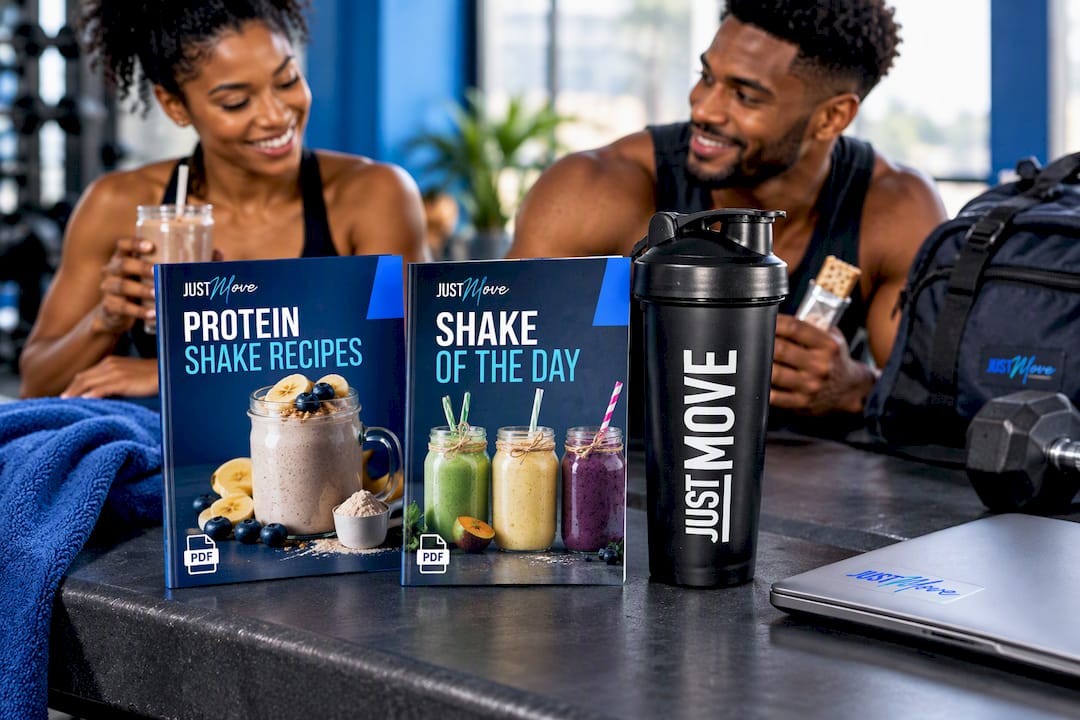
The Protein Shake Recipes Downloadable PDF gives you pre-built combinations that hit a strong protein-to-calorie ratio without guessing at ingredient amounts. If you want daily variety instead of drinking the same shake on repeat, the Shake Of The Day Downloadable Recipe PDF rotates flavors so your protein habit doesn’t get boring by week three. And since a shake is only as convenient as the container you’re mixing it in, the Just Move 20 oz. Shaker Cup makes it easy to mix and carry your shake straight from the gym to the car to your desk.
Browse the full protein and supplement collection to find the flavors and formats that fit your training schedule, and grab a recipe PDF today to start building shakes that actually match the numbers this article walked through.
This article is general information, not a substitute for advice from a qualified doctor. Consult a qualified healthcare professional about your own circumstances before acting on anything here.
FAQ
Is a Protein Bar or a Protein Shake Better?
Neither one is better across the board. Shakes typically deliver more protein per calorie and digest faster after training, while bars offer better satiety and portability for stretches without a kitchen.
Is It Better to Drink a Shake or Eat a Bar After a Workout?
A shake is usually the easier choice right after training, since liquid protein digests quickly when your appetite hasn’t fully returned. That said, protein timing has a smaller effect on results than most people assume, so a bar works fine too if that’s what’s on hand.
Can I Lose Weight Eating Only Protein Bars?
Weight loss depends on your total daily calories, not on whether protein comes from a bar. Bars can support a deficit if they replace a worse snack, but relying on them exclusively without tracking overall intake rarely produces lasting results.
Is There a Downside to Protein Bars?
Yes. Many bars use sugar alcohols and fillers that can cause bloating or digestive discomfort in sensitive people, and the fat and carbs used to hold a bar together often make it less protein-dense per calorie than a comparable shake.
Where Can I Find Recipes to Make Better Protein Shakes?
Justmovesupplements offers a downloadable shake recipe PDF with pre-built, protein-dense combinations, plus a daily recipe rotation PDF for variety. Current pricing for both is available directly on the product pages.
Pre workout is optional. Learn how to test one safely: check transparent labels, start at ¼–½ serving, track tolerance, and try a sample pack before you buy.
Learn the TSA 12 ounce powder rule and packing steps that prevent checkpoint delays. Use single-serve packets and an empty shaker to pass U.S. security fast.
Safety-first protein powder buying guide: run a two week trial, aim for 20–30g per serving, cap sugar, and confirm third party testing before you commit.
Consuming this product can expose you to chemicals including
Lead, which is known to the State of California
to cause cancer and birth defects or other reproductive harm.