Eccentric exercise damage, formally called exercise-induced muscle damage (EIMD), is the microscopic disruption to muscle fibers that happens when a muscle lengthens under tension, like lowering a dumbbell or absorbing your body weight on a downhill run. It differs from ordinary training fatigue because it involves structural tearing at the cellular level, not just metabolic exhaustion. The practical bottom line: symptoms typically build over 24 to 72 hours, strength recovers slower than soreness fades, and the safe move is progressive loading rather than pushing through sharp or one-sided pain.
- Soreness (DOMS) usually peaks 1 to 3 days after unfamiliar eccentric work.
- Blood markers like creatine kinase (CK) rise after damage but vary widely between people.
- Repeated exposure triggers the repeated-bout effect, your muscle’s built-in protection against future damage.
- Products from Just Move Supplements can support the nutrition side of recovery, and you might also consider creatine for bone health: use it with osteogenic loading to aid musculoskeletal support, though these do not replace smart training or medical care.
Key Takeaways
Eccentric exercise damage is a real, measurable, and largely predictable process that trades short-term soreness for long-term strength and resilience when programmed progressively.
| Point |
Details |
| EIMD is mechanical, not metabolic |
Lengthening under tension disrupts sarcomeres and triggers calcium-driven proteolysis. |
| Timeline is predictable |
Soreness peaks 24 to 72 hours post-exercise; strength recovers more slowly than soreness fades. |
| Repeated-bout effect protects you |
Progressive, submaximal eccentric exposure remains the most reliable damage-prevention strategy. |
| Velocity control matters |
Slower lowering phases reduce initial damage for the same training stimulus. |
| Nutrition supports repair |
Adequate protein and carbohydrate intake, paired with options like the Just MOVE Protein Sample Variety Pack, can support your recovery routine alongside sound training. |
Table of Contents
What Causes Muscle Damage During Eccentric Exercise?
The damage starts with mechanics, not chemistry. When a muscle lengthens while resisting a load, like your quadriceps controlling a squat’s descent, the tension per active fiber is higher than during concentric or isometric work. Fewer fibers are recruited to handle a comparable force, so each one absorbs more mechanical stress.
That stress disrupts the sarcomere, the muscle’s basic contractile unit, producing what researchers call Z-line streaming: a smearing or misalignment of the structural bands that normally hold the sarcomere in register. This mechanical injury increases the permeability of the sarcolemma, the muscle cell’s outer membrane, which lets calcium flood into the cell. That calcium influx activates calpains, a family of proteases that begin breaking down internal structural proteins. What began as mechanical strain becomes a secondary, self-propagating cascade of proteolysis.
- High-tension lengthening disrupts sarcomeres and produces Z-line streaming, visible under electron microscopy.
- Sarcolemma permeability increases, allowing calcium influx that activates calpain-driven protein breakdown.
- Mitochondria and the sarcoplasmic reticulum show measurable stress after unaccustomed eccentric loading, and the extracellular matrix around fibers can also sustain damage.
- Type II (fast-twitch) fibers tend to show more disruption than Type I fibers, likely due to their structural and metabolic profile.
Contraction velocity matters more than most lifters assume. Faster eccentric lengthening produces measurably greater strength loss and soreness than slow, controlled lowering, even when the total work performed is identical, according to research on eccentric exercise and muscle damage. Histological and imaging studies confirm this cascade with visible sarcolemmal disruption and swollen mitochondria after novel eccentric bouts, alongside elevated plasma CK, though these biomarkers correlate loosely with the actual degree of tissue injury.
How Does Eccentric Muscle Damage Show Up, and How Long Does It Last?
The clinical picture is fairly predictable once you know what to watch for. Expect a mix of delayed-onset muscle soreness (DOMS), joint stiffness, localized swelling, reduced force output, and sometimes a subtle loss of proprioception, your sense of joint position.
- Onset: mild soreness begins within hours after exercise.
- Peak: soreness and stiffness usually peak a day or two post-exercise.
- Recovery lag: force output and coordination often lag behind how sore you feel. You can feel fine and still produce less strength than baseline.
Blood tests tell part of the story but not the whole one. CK and myoglobin both rise after eccentric-heavy sessions, sometimes dramatically, but the same workout can produce a tenfold difference in CK response between two people of similar fitness. That variability means CK is useful for tracking your own trend over time, but it is a poor tool for comparing damage severity between individuals or diagnosing anything specific.
Where Eccentric Damage Actually Happens in Training

Eccentric loading is built into almost every major lift and movement pattern, whether you notice it or not. The lowering phase of a biceps curl, the descent in a back squat, downhill running, and the deceleration hamstrings perform when your foot strikes the ground during sprinting are all classic eccentric-dominant actions.
It helps to distinguish normal EIMD from an acute strain. DOMS builds gradually over a day or two and affects a broad muscle region; a strain produces sharp, localized pain at the moment of injury, often with immediate strength loss and sometimes bruising. If pain hits instantly, worsens with movement, or comes with visible swelling and a “pop” sensation, treat it as a possible strain and get it checked rather than assuming it’s just soreness.
Are the Risks of Eccentric Training Worth the Benefits?
Short-term, eccentric work is genuinely disruptive. First-time or high-intensity eccentric sessions can cause several days of elevated DOMS, temporary strength deficits, and in rare extreme cases, CK elevations significant enough to warrant medical attention. Jumping back into hard training before force output recovers raises injury risk, particularly for connective tissue.
The long-term payoff is where eccentric training earns its reputation. Systematic reviews and meta-analyses show eccentric training produces larger gains in strength, hypertrophy, and rate of force development than concentric training, even though it comes with more short-term soreness. Mechanistically, repeated eccentric loading drives sarcomerogenesis, the addition of sarcomeres in series, which lengthens muscle fascicles and shifts the length–tension relationship in a way that protects against future strain injuries. Some trials also report improved glucose handling after eccentric programs, though the evidence here is mixed.
- Short-term risks: extended DOMS, strength deficits, rare severe CK spikes, and premature return-to-play injury risk.
- Long-term benefits: greater strength and hypertrophy, sarcomerogenesis, improved length-tension properties, and some metabolic improvements.
- The repeated-bout effect, your muscle’s adaptation to a second exposure, reflects neural, structural, and connective tissue remodeling working together, not just one mechanism.
What Actually Speeds Up Recovery From Eccentric Damage?
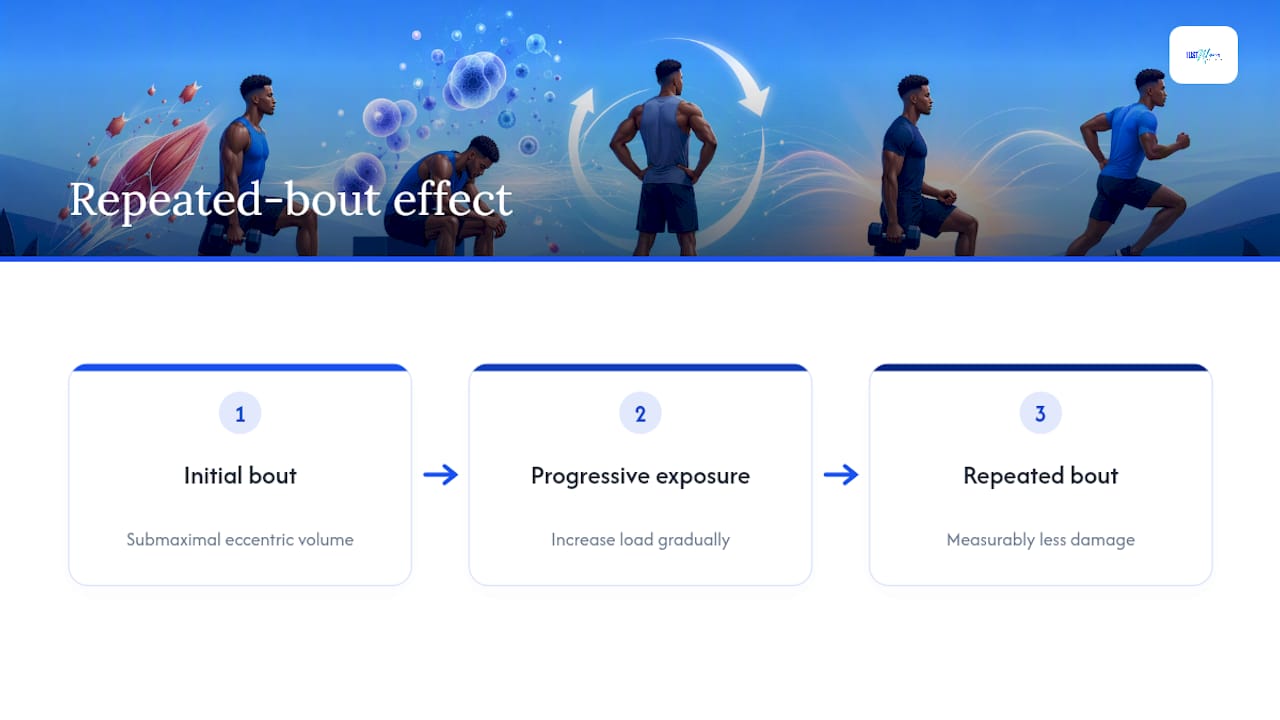
The single most effective prevention strategy isn’t a supplement or a recovery gadget. It’s progressive exposure: starting with submaximal eccentric volume and increasing load gradually so your muscle builds protection before you ask more of it. This is precisely what drives the repeated-bout effect, where a second bout of the same movement produces measurably less damage than the first.
Beyond programming, recovery basics still matter. Active recovery (light movement rather than complete rest) supports blood flow to damaged tissue. Adequate protein and carbohydrate intake gives your body the raw materials for repair. Getting recovery nutrition timing right matters more than most lifters assume, and understanding how carbohydrates support post-workout repair rounds out the picture. Cold and heat therapy have passionate advocates, but the evidence supporting either as a reliable accelerant for eccentric damage specifically is thinner than marketing suggests.
One clinical caution deserves attention: taking NSAIDs immediately around training sessions may blunt some of the adaptive signaling that drives muscle repair, so timing matters if you use them regularly. See a clinician if you notice sharp, localized pain instead of general soreness, weakness that doesn’t improve after several days, or unusually dark urine, which can signal a rare but serious condition called rhabdomyolysis.
Pro Tip: Instead of icing sore muscles by default, try tracking a simple functional test, like how many reps you can do at a given weight, alongside your soreness rating. Force output tells you more about real recovery than how tender a muscle feels.
A Simple Progressive Eccentric Protocol You Can Use
- Assess your baseline: pick one or two exercises and note your current strength and soreness tolerance before adding eccentric emphasis.
- Start with low-volume, submaximal eccentric work, controlling the lowering phase over 3 to 4 seconds rather than dropping fast.
- Train the movement 2 to 3 times per week, increasing load or volume by roughly 10% to 20% weekly if soreness and strength allow.
- Monitor recovery using a soreness scale, a simple strength or hop test, and how easily you handle daily tasks like stairs.
- Watch for urine color changes if you experience unusually intense soreness after a new eccentric program.
- If soreness lasts beyond 4 to 5 days or strength keeps declining session to session, cut volume by half and rebuild more slowly.
- Slower, controlled velocities reduce initial damage for a given amount of work, so prioritize control over speed early on.
How Clinicians Use Eccentric Loading for Rehab and Prevention
Eccentric training isn’t just a bodybuilding tool. Physical therapists use eccentric tendon-loading protocols for conditions like Achilles and patellar tendinopathy, and progressive eccentric hamstring work is a staple in ACL rehabilitation and hamstring-strain prevention programs. Its lower cardiovascular cost makes it appealing for populations with limited exercise tolerance, including some sarcopenia interventions in older adults.

That said, elite-athlete data is thinner than general population research, and clinicians typically individualize dosing based on tissue tolerance, injury history, and training age rather than applying one fixed protocol.
How Do Researchers Actually Measure Muscle Damage?
Muscle biopsy and histology remain the gold standard for confirming structural disruption, but they’re invasive and rare outside research settings. Most studies rely on indirect markers instead: CK, myoglobin, isokinetic strength testing, and imaging. Results vary substantially based on protocol design, training status, sex, age, and fiber-type distribution. CK in particular has real limits as a diagnostic tool since it correlates poorly with actual functional impairment.
Where to Read More on Eccentric Muscle Damage
Building Eccentric Training Into Your Routine Wisely
Gradual exposure beats aggressive intensity every time I’ve weighed the evidence on this topic. Patience with adaptation, paired with honest monitoring instead of guesswork, is what separates lifters who get stronger from those who spend weeks fighting soreness. Quality nutrition is part of that equation, and it’s worth pairing training discipline with resources like the recovery nutrition plan Justmovesupplements has put together for exactly this purpose.
Fueling Recovery After Eccentric Training
Recovering well from eccentric-heavy training comes down to timing as much as content. Protein intake spread across the day supports the repair processes described earlier, carbohydrate replenishment restores glycogen your muscles burned through, and hydration keeps everything moving efficiently.

If you’re rebuilding your post-workout routine, the Just MOVE Protein Sample Variety Pack lets you try seven flavors before committing to a full-size product, which takes the guesswork out of finding one you’ll actually enjoy drinking consistently. For readers managing body composition goals alongside recovery, Just Shred Green Apple Fat Burner is formulated to support energy and metabolism as part of a broader training plan. Neither product replaces sound programming, sleep, or medical advice. They’re built to complement the recovery habits already covered here. Head to the protein samples collection to pick your first flavors and start supporting your next training block.
Frequently Asked Questions About Eccentric Exercise Damage
Is eccentric exercise damage the same as a muscle strain?
No. EIMD is diffuse, delayed soreness from unfamiliar or intense eccentric loading, while a strain is a distinct, often sudden injury with immediate pain and localized weakness. If pain appears instantly rather than building over a day, treat it differently.
How long does eccentric muscle damage last?
Soreness typically peaks between 24 and 72 hours and resolves within about a week for most people, though full strength recovery can lag a few days behind how you feel.
Can you prevent eccentric exercise soreness completely?
Not entirely, but progressive, submaximal exposure using the repeated-bout effect meaningfully reduces damage on subsequent sessions compared to jumping straight into intense eccentric work.
Does eccentric training cause more damage than concentric training?
Should I stop training if I have DOMS?
Not necessarily. Light activity and continued training at reduced intensity is often fine. Stop and seek care if you notice sharp localized pain, persistent weakness beyond several days, or dark urine.
This article is general information, not a substitute for advice from a qualified doctor. Consult a qualified healthcare professional about your own circumstances before acting on anything here.
Sources
Recommended


