
- Article published at:
- Article author: Just MOVE Supplements
- Article tag: en
- Article comments count: 0
Discover the truth about protein powder shelf life and how to ensure safe, high-quality use beyond the expiration date. Learn more!
Learn More

Drawer menu

Protein powder texture is the full sensory and physical profile a powder creates when it hydrates — how completely it dissolves, how thick or thin the liquid feels, and whether it leaves behind grit, foam, or sediment. According to food-science research, the primary technical factors are particle size distribution, solubility, viscosity, and mouthfeel. When those factors are off, your shake feels wrong before you even taste it. The good news: most texture problems are fixable at home, and smarter shopping prevents them in the first place.
Quick wins to try right now:
Particle size, dispersibility, viscosity, and mouthfeel are the four physical levers that determine how a protein powder feels. Particle size and distribution describe how large the individual powder granules are and how evenly they are sized. Larger or unevenly sized particles tend to settle out, creating sediment at the bottom of your glass.
Dispersibility (sometimes called solubility) measures how readily those particles break apart and stay suspended in liquid. Viscosity is the thickness of the resulting drink — a casein shake feels noticeably heavier than a whey isolate mixed in water. Mouthfeel is the most personal factor: it describes how the liquid coats your tongue, moves across your palate, and lingers after you swallow.
Two additional factors round out the picture. Foam or air entrapment happens when proteins trap gas during mixing, leaving a frothy layer that some people find unpleasant. Sedimentation is the gritty layer that collects at the bottom when particles are too large or too dense to stay suspended. Together, these six properties combine into the descriptors you already know: chalky, gritty, silky, or slimy. Formulation choices like instantization and emulsifiers control all of them at the manufacturing level, which is covered in detail in the food-science section below.
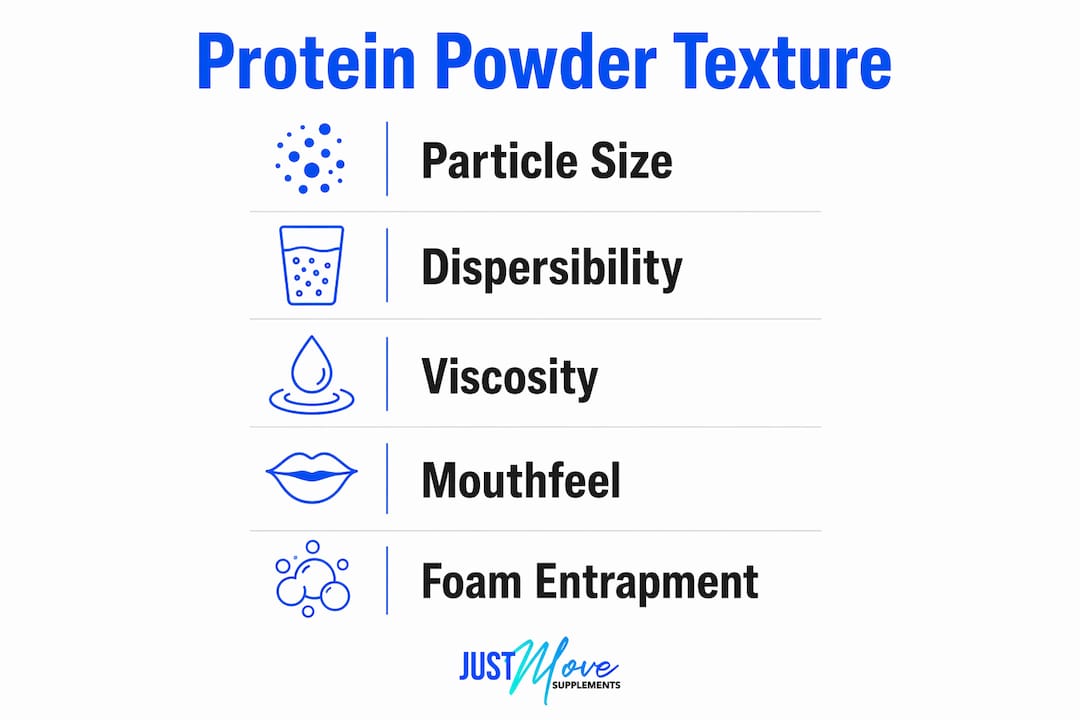
Most texture complaints fall into one of six categories. Knowing which one you are dealing with points you straight to the right fix.
Pro Tip: Flavor and temperature both amplify texture perception. Bitter or artificial sweetener notes make chalkiness feel more pronounced, and cold liquid slows hydration — which means a powder that seems fine at room temperature can feel noticeably grittier straight from the fridge.
Particle size is the most direct cause of grittiness. Larger particles resist full dissolution and scrape against the palate; uneven size distribution means some particles dissolve while others sink, creating both grit and sediment. Processing and filtration choices made during manufacturing determine those particle sizes before the powder ever reaches you.
Protein type matters just as much. Solubility differences between protein types are a leading cause of textural complaints: plant proteins and some collagen ingredients contain insoluble fractions that create grit or sediment, while whey isolates are described as “light and fast” and milk protein concentrates deliver a “milky, rounded” profile. Casein’s slower dispersibility is a feature for satiety but a liability for smooth mixing.
Processing and mineral enrichment add another layer. 2026 research shows that mineral concentration during filtration — not the protein itself — can increase mouth friction and create the chalky sensation many people blame on whey. Refining those filtration steps reduced mouth friction in pilot-scale trials.
Additives change the picture significantly. Guar gum absorbs water and forms a gel-like network that boosts creaminess and prevents separation; xanthan gum works similarly. Lecithin acts as an emulsifier, helping fat and water phases stay blended. Without these ingredients, low-fat formulations in particular tend to feel thin or grainy. Finally, storage matters: humidity causes powder particles to absorb moisture and cake together, and caked powder rehydrates unevenly, producing clumps even in powders that mixed perfectly when fresh.
Different protein sources behave very differently in liquid, and knowing what to expect saves real frustration.
| Protein Type | Typical Mouthfeel | Common Issues | Best Mixing Approach |
|---|---|---|---|
| Whey concentrate | Light, milky | Variable by brand | Shaker or blender |
| Whey isolate | Lean, slightly airy | Foam, thin feel | Blender; add fat or milk |
| Casein / milk protein | Thick, creamy | Clumping, slow dispersion | More liquid; blender |
| Pea / rice / plant blends | Earthy, can be gritty | Grit, sediment, chalkiness | Blender; extra liquid |
| Collagen peptides | Thin, watery | Lacks body | Combine with other proteins |
| Egg protein | Variable, can be fluffy | Foam, occasional chalkiness | Low-speed blend; rest before drinking |
Whey isolates and milk protein concentrates sit at opposite ends of the mouthfeel spectrum. Isolates are lean and fast-dissolving but can trap air and feel foamy without an emulsifier. Casein and milk protein concentrates provide real body and creaminess, though they need more liquid and more mixing time to avoid clumps.

Plant proteins — pea, rice, and blended formulas — are the most prone to grit and chalkiness because of larger particle sizes and insoluble fiber content. They benefit most from blending and benefit greatly from added fat or yogurt. Collagen peptides dissolve easily but feel watery on their own; pairing them with a creamier protein source fills in the mouthfeel gap. Egg protein is variable: it can feel fluffy or chalky depending on how it was processed, and it tends to foam more than whey. For plant proteins especially, check whether the label says “instantized” before you buy.
Work through this list in order. Most texture problems resolve by step three.
Two quick recipes that reliably improve texture:
Pro Tip: Add liquid to the blender first, then the powder. This prevents dry powder from sticking to the blades and ensures more even hydration from the start. For a blender-free option, check out common shake mistakes to avoid the habits that make texture worse.
Reading a label carefully before you buy is the single most reliable way to avoid texture disappointment. Here is what to check:
Pro Tip: Always buy the smallest available size or a sample pack the first time you try a new powder. Texture preferences are personal, and flavor masking cannot reliably fix a powder with poor wetting — no amount of chocolate flavoring rescues a chalky base.
For readers who want to compare unflavored versus flavored options before committing, protein powder alternatives can also help you understand which ingredient matrices tend to deliver the smoothest results. Protein snack texture preferences follow similar patterns, as consumer research on protein snack selection confirms that mouthfeel is consistently one of the top purchase drivers.
A sudden change in how your powder mixes — especially when combined with an off smell — is worth taking seriously. Unusual clumping after proper storage, visible mold, or a sour or rancid odor all indicate spoilage. Discard the product and do not consume it.
Some texture-modifying ingredients can cause GI discomfort in sensitive people. Guar gum and xanthan gum are generally well tolerated, but high amounts can cause bloating or loose stools. Plant proteins can trigger food-allergy responses in people sensitive to soy, pea, or rice. If you notice consistent GI upset after switching powders, check the ingredient list for new gums or a different protein source.
Storage checklist to protect texture over time:
Pro Tip: If you experience swallowing difficulty, persistent gagging, or any allergic symptoms (hives, swelling, shortness of breath) after consuming a protein shake, stop use and consult a doctor. This article is general information, not medical advice — always confirm specific health concerns with a qualified clinician.
Powder rheology is the study of how powders flow, compress, and interact with moisture. Food scientists use rheology tools — measuring flowability, wall friction, and bulk density — to predict how a powder will behave during mixing, storage, and transport. Those properties translate directly into what you feel in your mouth: a powder with poor flowability tends to clump; one with high moisture uptake cakes in the container.
Instantization is the manufacturing process that most directly improves consumer-perceived texture. It typically involves agglomerating fine particles into larger, more porous clusters and coating them with an emulsifier like lecithin. The result: the powder wets faster, floats less, and disperses more evenly. Instantized powders dissolve more quickly and encapsulation can mask undesirable textures while aiding dispersion.
The 2026 research on whey palatability adds an important nuance:
“Unpleasant chalky or dry texture in whey drinks is often driven by processing methods — specifically mineral concentration during filtration — rather than an inherent fault of the protein itself. Refining filtration steps reduced mouth friction and improved smoothness in pilot-scale trials.” (phys.org, 2026)
The practical implication for shoppers: if a whey powder feels chalky, the issue may be the manufacturer’s filtration process rather than whey protein as a category. Brands that invest in refined filtration and instantization deliver measurably smoother results. What manufacturers can reasonably be expected to control includes particle size, emulsifier inclusion, and instantization. What remains a formulation trade-off is the balance between protein purity, added stabilizers, and cost — which is exactly why best blends are engineered backward from desired mouthfeel, not from raw protein percentage alone.
Protein powder texture is determined by particle size, solubility, viscosity, and mouthfeel — and blending method plus protein type are the two factors you control most directly.
| Point | Details |
|---|---|
| Texture defined | Particle size, dispersibility, viscosity, and mouthfeel combine to create smooth, gritty, chalky, or foamy shakes. |
| First fix to try | Use a blender, increase liquid to at least 10–12 oz per scoop, and let the powder hydrate 30–60 seconds before drinking. |
| Label cues that matter | Look for “instantized,” lecithin or emulsifiers, and gums (guar, xanthan) — these signal better protein powder consistency. |
| Storage protects texture | Seal tightly, store away from heat and humidity, and use before the best-by date to prevent caking and poor rehydration. |
| Justmovesupplements sample packs | Try individual flavors like Chocolate Cake Protein or Unflavored Protein before buying a full tub to test texture risk-free. |
The conventional advice is to just “blend better” or “add more water.” That advice is not wrong, but it misses the bigger point: texture is largely decided before you open the bag. The manufacturing choices — filtration quality, instantization, emulsifier inclusion, particle size control — set a ceiling on what any mixing technique can achieve. You can smooth out a mediocre powder with a blender and nut butter, but you cannot fully rescue one that was poorly engineered from the start.
What this means practically is that the label is your first line of defense, not the blender. A powder that lists “instantized,” sunflower lecithin, and a clean protein source is almost always going to outperform one that lists none of those things, regardless of how aggressively you mix it. Flavor masking cannot fix poor wetting — as formulation research confirms, flavor systems interact with protein matrices, and no amount of chocolate flavoring rescues a chalky base.
Three rules worth keeping: start with a sample before buying a full tub, always use a blender for plant proteins, and choose instantized formulations if grit is your biggest complaint. Testing and adjusting your recipe is a normal part of finding the right powder — it does not mean protein shakes are not worth it.
Buying a full-size tub of protein powder without testing the texture first is one of the most common and avoidable frustrations in fitness nutrition. Justmovesupplements offers sample packs specifically designed to solve this problem, letting you test flavor, mixability, and mouthfeel before you invest in a larger size.
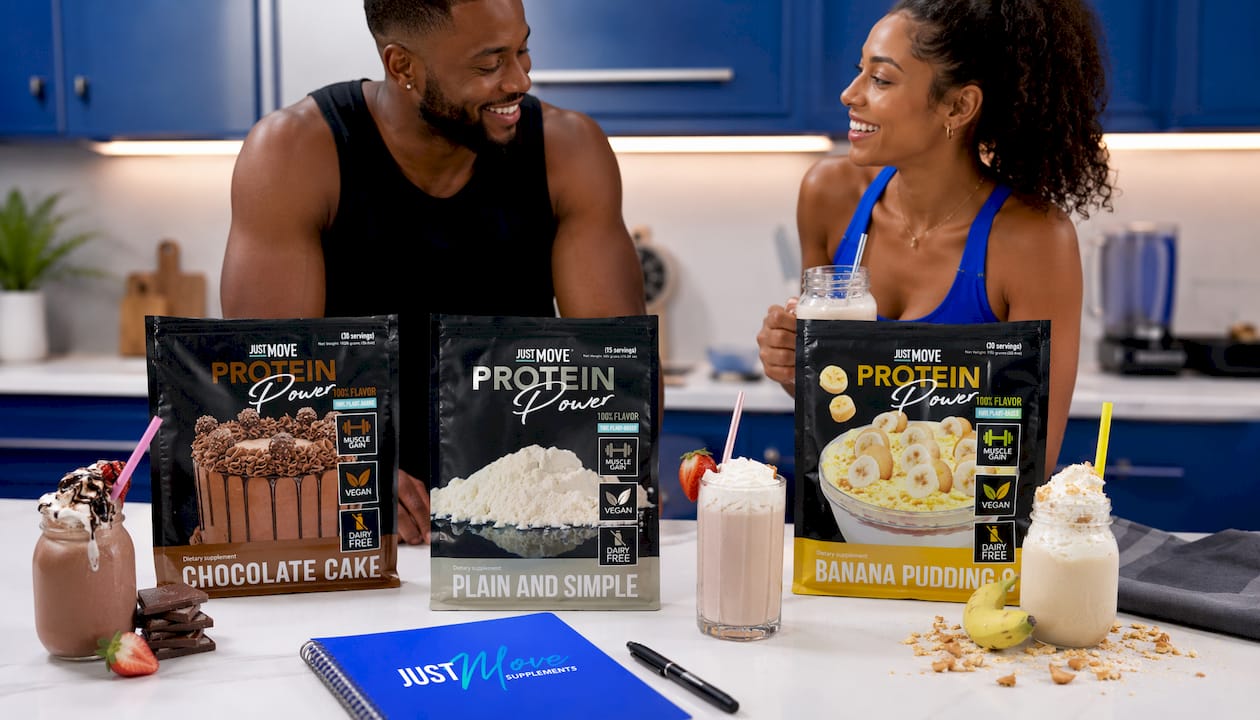
Three standout options to start with: the Chocolate Cake Protein gives you a rich, flavored baseline to evaluate how well a formulated powder disperses and coats the palate. The Plain And Simple Unflavored Protein strips away flavor variables entirely, making it the cleanest way to judge raw solubility and mouthfeel on their own terms. The Banana Pudding Protein shows how a different flavoring matrix interacts with texture — useful if you want to see whether a dessert-style formula feels heavier or creamier than a neutral base. Visit Justmovesupplements to explore the full sample range and find the texture that works for you.


Consuming this product can expose you to chemicals including Lead, which is known to the State of California to cause cancer and birth defects or other reproductive harm.
For more information, go to www.P65Warnings.ca.gov/food .