DOMS stands for delayed-onset muscle soreness, the dull pain and stiffness that shows up 24 to 48 hours after unfamiliar or unusually hard exercise. It’s the reason your legs feel like concrete two days after your first squat session in months, not the day of.
Here’s what you need to know right away, drawn from clinical sources like the Cleveland Clinic and research summarized on NCBI Bookshelf:
-
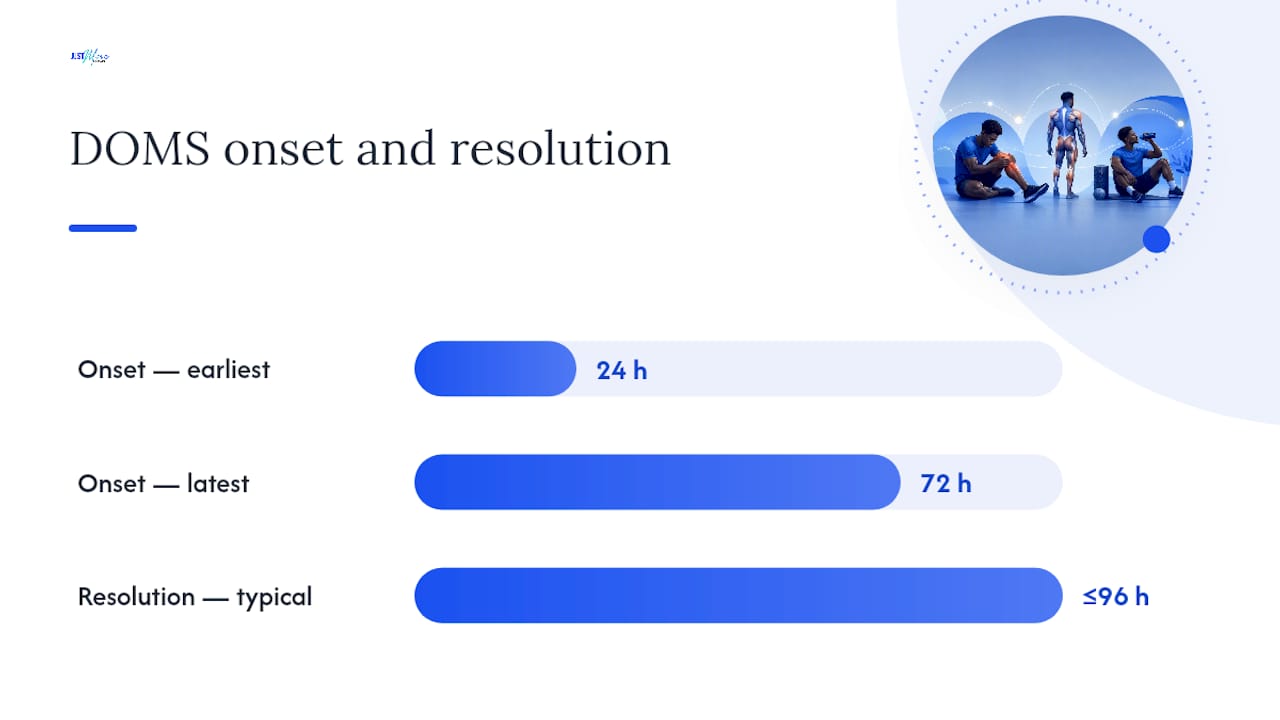
Onset: Symptoms typically begin 24 to 72 hours after exercise, not immediately.
-
Peak: Soreness usually peaks between 24 and 72 hours, often landing hardest around day two.
-
Duration: Most people recover within about four days, though it can stretch longer after a particularly brutal session.
Two things trip people up constantly. First, DOMS has nothing to do with lactic acid. That myth has been debunked for years. Second, feeling sore doesn’t mean your workout “worked” and feeling nothing doesn’t mean it failed. DOMS often shows up after eccentric loading, like the lowering phase of a lunge, but it’s a byproduct of unfamiliar stress, not a requirement for muscle growth. At Justmovesupplements, we hear this confusion constantly from gym-goers chasing soreness as a badge of honor. It’s not the goal. It’s just a signal your body is adapting.
Key Takeaways
DOMS is delayed-onset muscle soreness caused by microscopic muscle damage and inflammation, not lactic acid, and it typically resolves within four days with basic, evidence-supported recovery habits.
| Point |
Details |
| Definition and timing |
DOMS is delayed muscle soreness starting 24 to 72 hours after unfamiliar exercise, peaking in that same window. |
| Mechanism, not lactic acid |
Microscopic muscle fiber tears and inflammation cause DOMS; lactic acid buildup is a myth. |
| Know the red flags |
Sharp pain, disproportionate swelling, or symptoms past five to seven days need medical evaluation. |
| Recovery tools manage symptoms |
Active recovery, massage, and heat ease discomfort but don’t speed up tissue repair itself. |
| Repeated exposure reduces soreness |
The repeated-bout effect means the same movement causes less soreness the second time around. |
| Support recovery with real nutrition |
Consistent protein intake, like from the Just MOVE Protein Sample Variety Pack, helps you meet daily targets without dreading your shake. |
Table of Contents
What Does DOMS Mean at the Muscle Fiber Level?
The soreness itself traces back to what’s known as the microtrauma theory, and it’s the explanation most widely accepted in exercise science today. When you push muscles through movement patterns they aren’t used to, especially the lengthening (eccentric) phase of a lift, you create microscopic tears in muscle fibers and the connective tissue surrounding them. Your body responds with an inflammatory process, and that inflammation, not any buildup of lactic acid, produces the ache you feel a day or two later. Medical News Today lays out this mechanism clearly, and it’s echoed across clinical literature reviewed on NCBI Bookshelf.
Picture it in four steps: muscle fiber under unfamiliar load, microscopic tearing at the cellular level, an inflammatory response as your body sends repair signals, then the soreness you actually feel as that repair process unfolds. It’s a straightforward chain, but it explains why DOMS feels like a slow burn rather than a sudden jolt.
This is fundamentally different from two other things people often confuse with DOMS:
-
Acute muscle soreness happens during or immediately after exercise, driven by metabolic byproducts and fatigue in the moment. It fades within minutes to hours.
-
Orthopedic injury (a torn ligament or strained tendon) hits with sharp, immediate pain, often at the moment of injury, not a day or two later.
DOMS sits in a category of its own: delayed, dull, and gradually building rather than sudden and sharp.
Pro Tip: If you want to blunt next week’s soreness, don’t jump straight into your hardest eccentric-focused workout. Ease into new movement patterns over two to three sessions. Your muscles adapt fast to repeated stress, a phenomenon called the repeated bout effect, and that adaptation is one of the most reliable ways to reduce future DOMS severity.
The onset and duration numbers matter here because they’re diagnostic. Clinical sources consistently point to a 24 to 72 hour onset window with resolution typically inside four days, and when soreness falls outside that pattern, it’s worth paying attention.
What Are the Common Symptoms and Causes of DOMS?
DOMS has a recognizable timeline. Symptoms are usually absent immediately after the workout, begin creeping in within a day, intensify over the following 24 to 48 hours, and then taper off as muscle tissue repairs itself. Most people are back to feeling normal within four days, though a genuinely brutal session (think your first marathon or a downhill trail run you weren’t prepared for) can stretch that timeline a bit longer.
The symptoms themselves are fairly consistent from person to person:
- A dull, aching sensation rather than sharp pain
- Stiffness, especially first thing in the morning or after sitting for a while
- Tenderness when you press on the affected muscle
- Reduced range of motion in the joint the muscle crosses
- A general feeling of tightness through the muscle belly
- A temporary drop in strength output below your normal capacity
What actually causes it comes down to the type of contraction your muscles just performed. Eccentric contractions, where the muscle lengthens under tension, generate significantly more microtrauma than concentric or isometric work, according to research summarized on Wikipedia’s overview of DOMS mechanisms. That’s why certain activities are notorious DOMS triggers:
- The lowering phase of a heavy squat or deadlift
- Downhill running or hiking
- Plyometric work like box jumps, particularly the landing
- Any new exercise your body hasn’t adapted to yet
- A sudden jump in training volume or intensity, even in familiar movements
Not every ache is DOMS, though, and knowing the difference protects you from training through an actual injury. Watch for these red flags:
- Pain that’s sharp, stabbing, or localized to a joint rather than a muscle belly
- Swelling that seems disproportionate to how hard you trained
- Any loss of function, like an inability to bear weight or fully extend a limb
- Soreness that persists beyond five to seven days or gets progressively worse instead of better
Cedars-Sinai notes that timing and pain quality are exactly what clinicians use to separate DOMS from something more serious. If your pain fits that second category, it’s time to get it looked at rather than wait it out.
How Do You Tell DOMS Apart From a Real Injury?
Run through a quick self-check before assuming the worst, or before ignoring something that needs attention. Move the affected muscle through its full range of motion. DOMS tends to feel like resistance and stiffness throughout the movement, while an injury often produces a sharp catch or block at a specific point. Ask yourself whether the pain is dull and diffuse (DOMS) or sharp and pinpointed (possible injury). If you trained one side of your body, compare performance and sensation bilaterally. A stark asymmetry beyond what you’d expect from the exercise itself is worth noting.
Certain signs should send you straight to a healthcare provider rather than waiting it out at home:
- Severe swelling well beyond mild puffiness
- Inability to bear weight or use the limb normally
- Complete loss of function in a joint or muscle group
- Fever accompanying muscle pain
- Dark or tea-colored urine, which can signal rhabdomyolysis, a rare but serious breakdown of muscle tissue that requires urgent care
Research on exercise-related rhabdomyolysis makes clear this condition, while uncommon, needs to be ruled out when someone presents with extreme, disproportionate muscle pain after intense or unaccustomed exercise.
If you do see a clinician for persistent or worrying muscle pain, expect a physical exam and a detailed history first. Imaging like X-rays or MRI usually only comes into play if a structural injury (a tear or fracture) is suspected. Blood tests measuring creatine kinase (CK) levels can help confirm or rule out significant muscle breakdown when rhabdomyolysis is on the table. For general back pain specifically, Garden State Medical Group’s guidance on when to see a doctor offers a useful parallel framework for deciding when self-care isn’t enough. Ordinary DOMS almost never needs any of this. It needs time, and the strategies covered next.
What Actually Helps Relieve DOMS Symptoms?
Here’s where expectations need to be realistic. Reviews of recovery interventions consistently show that certain methods ease the feeling of soreness without meaningfully speeding up the underlying tissue-repair timeline. A review of recovery modalities on PubMed found massage and active recovery reduced perceived soreness fairly reliably, while evidence for cold water immersion and compression garments was mixed, with study quality varying a lot from trial to trial. That distinction, symptom relief versus biological repair, matters when you’re deciding what’s worth your time.
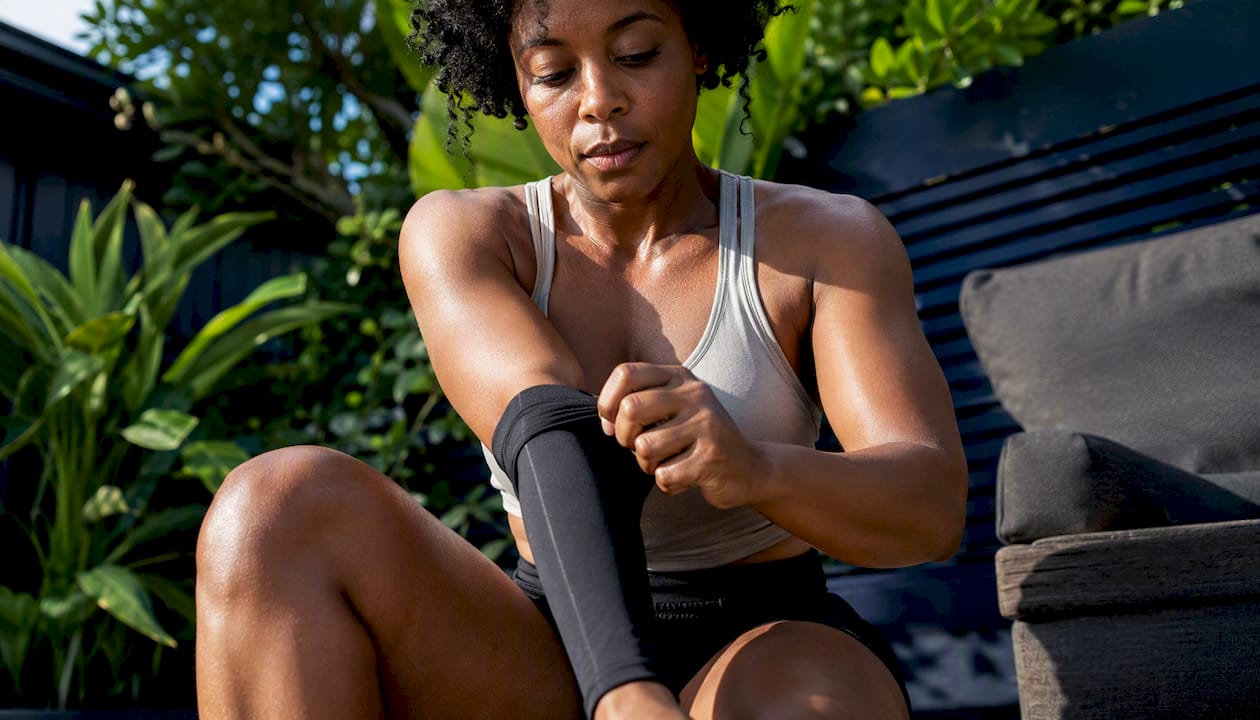
Medical News Today points to a similar pattern: active recovery, massage, heat therapy, and adequate rest all help take the edge off, but none of them eliminate the repair process your muscles are working through. NSAIDs like ibuprofen can reduce pain in the short term, but they come with their own limits and shouldn’t become a habit without checking for contraindications, especially if you have any history of stomach or kidney issues.
A practical recovery session, whether it’s the day after leg day or the morning after your first spin class in a year, might look like this:
- Start with 10 to 15 minutes of light movement (walking, easy cycling) rather than staying fully sedentary
- Foam roll the affected muscle group for two to three minutes per area
- Apply heat if the muscle feels tight and stiff, or contrast between heat and cold if you prefer
- Prioritize sleep. Most repair work happens overnight, and skimping on rest slows everything down
- Eat enough protein across the day to support the repair process your body is already doing
- Stay hydrated. Dehydration makes everything feel worse, including soreness
- Use a topical analgesic if you want localized relief without systemic medication
- Consider NSAIDs cautiously and only if pain is genuinely limiting, not as a default step
- Keep moving gently through the soreness rather than avoiding the muscle entirely
- Avoid stacking another maximal-effort session on the same muscle group until soreness eases
- Track how you feel day to day so you can spot anything outside the normal DOMS pattern
- Give it time. Four days is typical; rushing rarely helps
Pro Tip: When you’re ready to train that muscle group again, don’t jump back to full intensity. Your nervous system and connective tissue need a beat to catch up, even after the soreness itself has faded.
Modalities like cryotherapy chambers and compression garments get a lot of marketing attention, but the evidence behind them is thinner than for basics like sleep and light movement. If you enjoy them and they fit your budget, they’re not harmful. Just don’t expect them to outperform a good night’s sleep and a properly timed protein intake, which research on nutrition and muscle recovery continues to support as foundational. For a deeper look at structuring your post-workout eating window, Justmovesupplements’ recovery nutrition plan breaks down timing and macronutrient targets in more detail.
The bottom line on treatment: these tools manage discomfort. They don’t accelerate the biological clock your muscle tissue is running on.
How Long Does DOMS Usually Last?
Stick to the pattern most people experience: onset within 24 to 72 hours, peak soreness somewhere in that same window (usually landing hardest around day two), and resolution within about four days for the majority of cases. Individual variation exists, and a genuinely extreme session can push that timeline a day or two further.
- Day 0 to 1: Little to no soreness yet, sometimes a faint tightness
- Day 1 to 3: Soreness builds and typically peaks
- Day 3 to 4: Symptoms begin easing as repair progresses
- Beyond day 5 to 7: Should be resolved. Persistent pain past this point warrants a closer look
The repeated-bout effect is one of the more useful things to understand here. The first time you do a new movement, or push volume up sharply, you get hit hard. Do that same movement again within a couple of weeks, and the soreness is noticeably milder, even at the same intensity. Your muscle has adapted structurally to handle that specific stress. Practically, this means the second and third time you run downhill, do a new leg day variation, or add plyometric work, you should expect (and can plan around) less disruption than the first go.
DOMS, when it follows this pattern, isn’t something to worry about. It’s a normal part of adapting to new physical demands. Pain that worsens instead of improving, or that lingers well past a week, is the signal to get it checked rather than push through.
How Can You Prevent Severe DOMS Next Time?
You can’t eliminate DOMS entirely, and you probably don’t want to. Some soreness after genuinely new or hard training is normal. But you can meaningfully reduce how brutal it gets with a few deliberate strategies.
-
Progress gradually. Increase training volume or intensity by roughly 10% to 20% per week rather than making dramatic jumps. This gives your connective tissue time to adapt alongside your muscles.
-
Control your eccentric tempo. Instead of dropping fast into the lowering phase of a lift, slow it down intentionally for a few sessions when introducing a new movement. This builds tolerance without maximizing damage on day one.
-
Stay consistently active. Muscles that get regular, moderate use handle new stress better than muscles coming out of a long layoff.
-
Warm up specifically. A dynamic warm-up that mimics the movement pattern you’re about to load, plus a set or two of light eccentric prep work, primes the tissue before you go heavy.
-
Cool down and support recovery nutrition. Adequate protein intake throughout the day and smart carbohydrate timing after training both support the repair process your muscles need.
A simple four-week approach to introducing eccentric-heavy work looks like this: in week one, use light loads with controlled tempo and stop well short of failure. Week two, add a modest load increase while keeping the same controlled tempo. Week three, introduce slightly higher volume at the same intensity. Week four, you can push closer to your normal training intensity, since the repeated-bout effect should already be working in your favor.
Sleep matters just as much as anything on this list. Growth hormone release and tissue repair both ramp up during deep sleep, so cutting sleep short while ramping up training volume is asking for worse soreness, not better adaptation.
What Does the Research Actually Say About DOMS?
The mechanistic explanation for DOMS, microtrauma followed by inflammation, has fairly consistent support across clinical literature, including the detailed overview in NCBI Bookshelf’s chapter on exercise-induced muscle damage. Where things get murkier is on the treatment side. Not every recovery method has strong evidence behind it, and study quality varies more than marketing claims would suggest.
-
NCBI Bookshelf review: Establishes the mechanism (microtears, inflammatory response) and outlines conservative management as the standard approach.
-
PubMed review on recovery modalities: Massage and active recovery show fairly consistent benefit for perceived soreness; cold water immersion and compression show mixed results.
-
PMC review on exercise recovery research: Flags that many DOMS studies rely on small sample sizes or inconsistent outcome measures, which weakens how confidently we can generalize findings.
-
Cedars-Sinai clinical guidance: Reinforces that pain timing and quality remain the most practical tools for distinguishing DOMS from injury.
The honest picture: researchers agree on why DOMS happens at the tissue level, but there’s no single modality proven to dramatically shorten the timeline. What works is managing discomfort while your body does the repair work on its own schedule.
That gap between mechanism and treatment evidence is worth sitting with. It’s the difference between “we understand this” and “we can fix this faster,” and right now, the honest answer for most recovery modalities is closer to the former than the latter.
Why We Think Sensible Recovery Beats Chasing Quick Fixes
After years of watching people obsess over recovery hacks while ignoring the basics, the case for keeping things simple feels stronger every year. Sleep, protein, and gradual progression outperform almost every gadget or supplement stack on the market, and the research backs that up more consistently than it backs any single “miracle” recovery tool.
That doesn’t mean supplements have no place. Getting enough protein daily is genuinely harder than most people assume, especially on busy training weeks, and a product like the Just MOVE Protein Sample Variety Pack exists to solve a real, practical problem: finding a protein you’ll actually enjoy drinking consistently. Hydration and reasonable sleep support (not sedatives, just genuinely restorative aids) round out a sensible recovery approach. None of this treats DOMS. It supports the body doing what it’s already built to do.
We stay evidence-minded here because fitness enthusiasts deserve honesty over hype. Supplements are an adjunct to good training and good sleep, never a replacement for either.
Support Your Recovery With the Right Protein, Not Guesswork
Hitting your daily protein target consistently is one of the more reliable things you can control while your muscles handle the repair work DOMS signals. Justmovesupplements built the Just MOVE Protein Sample Variety Pack specifically so you can test seven flavors before committing to a full-size tub, which matters a lot if you’ve ever bought a big bag of protein powder you ended up dreading every morning.

This isn’t a treatment for sore muscles, and severe or unusual symptoms always call for a healthcare provider, not a supplement. But for the everyday soreness that comes with progressing your training, having a protein you’ll genuinely drink consistently removes one variable from the recovery equation. If fat loss support is part of your goals alongside recovery, the Just Shred Green Apple Fat Burner rounds out a broader approach. Browse the protein sample collection and pick your first pack today.
Frequently Asked Questions
What does DOMS mean in simple terms?
DOMS means delayed-onset muscle soreness, the ache and stiffness that appears one to three days after tough or unfamiliar exercise, driven by microscopic muscle damage rather than anything happening during the workout itself.
Is DOMS a sign that your workout was effective?
Not necessarily. DOMS signals unfamiliar stress on a muscle, not necessarily muscle growth. You can build strength and size with minimal soreness once your body adapts through the repeated-bout effect.
How is DOMS different from a pulled muscle?
DOMS is delayed, dull, and diffuse across a muscle belly, while a pulled muscle or strain hits immediately with sharp, localized pain, often right at the moment of injury.
Should you work out with DOMS?
Light to moderate activity is generally fine and can even ease stiffness, but avoid maximal effort on the same muscle group until soreness eases, typically within four days.
When should DOMS prompt a doctor visit?
See a healthcare provider if pain is sharp rather than dull, swelling seems severe, you lose function in the limb, or symptoms persist beyond five to seven days.
This article is general information, not a substitute for advice from a qualified doctor. Consult a qualified healthcare professional about your own circumstances before acting on anything here.
Sources
Recommended


