Amino acid powder is a concentrated, free-form supplement delivering individual or full-spectrum amino acids directly into your bloodstream without digestion. It’s most useful for peri-workout support, filling protein gaps on low-intake days, and preserving lean mass during calorie-restricted phases. The short answer: if you’re hitting your daily protein targets through whole food and quality protein shakes, an extra amino powder is largely optional. If you’re training fasted, eating below your protein needs, or managing a restricted diet, it can make a real difference.
-
Use it peri-workout when you want a fast-acting amino spike around training, especially if your last meal was hours ago.
-
Use it to fill dietary gaps when daily protein falls short, you’re training fasted, or you follow a plant-based diet with incomplete amino acid profiles.
-
Stick with whole-food protein when your diet already delivers adequate protein (roughly 1.6–2.0 g/kg of body weight daily) and you don’t have specific timing constraints.
Who should consider them most seriously: competitive athletes subject to drug testing (look for NSF Certified for Sport or Informed-Choice certification), busy lifters who train early or late without a meal nearby, and people on vegan or calorie-restricted diets. Justmovesupplements recommends prioritizing a full-spectrum Essential Amino Acid (EAA) formula with at least 2,000 mg of leucine per serving over BCAA-only products.
Table of Contents
What is amino acid powder, and how do the main types differ?
The human body requires 20 amino acids to build and repair tissue, produce hormones, and support virtually every metabolic process. Nine of those are essential, meaning your body cannot synthesize them and must get them from food or supplements. Amino acid powder delivers these building blocks in free-form, meaning they’re already broken down and ready to absorb. Unlike a protein powder, which requires digestion to release amino acids, free-form powders raise blood amino acid levels rapidly without that digestive step.
The main categories you’ll see on labels:
-
Essential Amino Acids (EAAs): All nine essential amino acids in one formula. This is the most complete option and the one modern sports nutrition research consistently favors for muscle protein synthesis (MPS).
-
Branched-Chain Amino Acids (BCAAs): Only three EAAs — leucine, isoleucine, and valine. They trigger an anabolic signal but lack the remaining six EAAs needed to actually complete protein synthesis.
-
Single-amino powders: Isolated amino acids like L-citrulline (performance and blood flow), L-arginine (nitric oxide support), or L-glutamine (gut health and recovery). These serve specific physiological functions rather than broad MPS support.
-
Conditionally essential amino acids: Amino acids like glutamine, arginine, and glycine that the body can usually produce but may need in higher amounts during illness, surgery, or intense training blocks.
When reading a Supplement Facts panel, look for the total grams per serving, the individual amino acid breakdown (not a proprietary blend), and the leucine content specifically. Leucine is the primary trigger for MPS, and a serving should deliver at least 2,000 mg to meaningfully stimulate that process. Free-form amino acids are notoriously bitter, which is why most powders add flavoring agents and sweeteners. That bitterness is a sign the aminos are present and free-form, not bound in a protein matrix. For plant-based protein completeness and when EAA supplementation adds value for vegans, the amino acid profile of your base diet matters enormously.
What does the evidence say about amino acid powder benefits?
The clinical evidence is genuinely promising in specific contexts, and modest in others. Here’s where the research lands:
-
Muscle protein synthesis: EAA supplementation peri-workout produces a measurable boost in MPS, particularly when leucine content is sufficient. This effect is well-documented in both younger and older adults.
-
Clinical muscle preservation: Amino acid supplementation can prevent loss of muscle volume in post-surgical and clinical wasting scenarios, which is where some of the strongest trial data exists.
-
Short-term recovery: Studies show reduced markers of muscle damage and soreness with EAA supplementation around training, though effect sizes in healthy, well-fed athletes tend to be smaller.
-
Cognitive and neurotransmitter support: Several amino acids serve as precursors to neurotransmitters, meaning adequate intake supports cognitive function and focus beyond just muscle repair.
-
Where evidence is weaker: Fat loss, immune enhancement, and general “wellness” claims attached to amino powders are not well-supported by clinical trials in healthy populations.
Statistic callout: The clinical-serving range for EAAs most commonly recommended for peri-workout use is 6–12 g per serving, with leucine content of at least 2,000 mg per dose to reliably trigger MPS.
The practical takeaway for recreational lifters: amino acid powders work best as a targeted tool, not a daily staple. Experts recommend using them to fill gaps when dietary protein is inadequate, not as a replacement for whole-food protein. If your daily protein is already on track, the incremental benefit of adding an amino powder is small. If you’re training fasted or running a calorie deficit, the benefit becomes much more meaningful. For more on using protein as a nutritious meal replacement, the gap-filling strategy applies there too.

How does amino acid powder differ from protein powder?
These two products solve related but distinct problems. Understanding the difference helps you decide which one belongs in your stack, and when you might not need both.
| Factor |
Amino Acid Powder |
Protein Powder |
| Absorption speed |
Rapid (no digestion required) |
Slower (digestion releases amino acids) |
| Calories per serving |
Very low (typically under 25 kcal) |
Moderate to high (over 100 kcal) |
| Satiety |
Minimal |
Meaningful |
| Amino acid completeness |
Full with EAA formulas; partial with BCAAs |
Full with whey, casein, or complete plant blends |
| Best use-case |
Fasted training, intra-workout, calorie-restricted phases |
Post-workout recovery, meal replacement, daily protein target |
Three scenario-driven recommendations:
-
Pre- or intra-workout, training fasted: An EAA powder (6–12 g) is the better choice. It delivers amino acids quickly without the caloric load or digestive demand of a full protein shake.
-
Post-workout, well-fed: A quality protein powder covers your needs. If it already delivers 20–30 g of complete protein, a separate amino powder adds little.
-
Calorie-restricted cut or weight-loss phase: A small EAA serving helps preserve lean mass without adding significant calories, making it a smarter gap-filler than a full protein shake in some cases.
When a protein powder already provides a complete amino acid profile at clinical doses, adding a separate amino product is unnecessary. The label tells you: if the protein powder lists all nine essential amino acids with adequate leucine, you’re covered. For context on high-protein meal replacement strategies, the same logic applies.
How to use amino acid powder effectively
Dosing and timing
The clinical-serving range for EAAs is 6–12 g per serving. Leucine should hit at least 2,000 mg per dose to trigger MPS reliably. For single-amino powders like L-citrulline, dosing is purpose-specific and typically higher (6–8 g for performance benefits).
Timing windows:
-
Pre-workout (30–60 minutes before): Ideal when training fasted or when your last meal was 3+ hours ago. A fast-absorbing EAA dose primes MPS before the session starts.
-
Intra-workout: Small sips of an EAA mix during longer sessions (60+ minutes) can sustain amino acid availability and reduce muscle breakdown mid-training.
-
Post-workout (within 60 minutes): Effective if you haven’t consumed protein around the session. Less critical if you’re eating a complete protein meal within 1–2 hours.
-
Fasted morning training: An EAA serving before or during the session limits catabolism without breaking a fast in a meaningful caloric sense.
Pro Tip: During a calorie-restricted phase, a 6 g EAA serving before training delivers the leucine threshold needed to preserve lean mass while adding fewer than 25 calories. It’s one of the most efficient tools for maintaining muscle on a cut.
Stacking, mixing, and palatability

| Combination |
Why it works |
| EAAs + carbohydrates |
Carbs spike insulin, which amplifies amino acid uptake into muscle cells |
| EAAs + electrolytes |
Supports hydration during intra-workout use, especially in heat |
| EAAs + caffeine (pre-workout) |
Caffeine enhances training output; EAAs support MPS simultaneously |
| EAAs + whole-food protein meal |
Redundant if the meal already hits 30+ g complete protein |
Free-form amino acids mix poorly in plain water and taste bitter on their own. Mix them in juice, a smoothie, or a flavored protein shake to mask the bitterness and improve adherence. Avoid adding free-form amino powders to baked goods or hot liquids; heat can degrade free-form amino acids and reduce their effectiveness. For pre-workout snack pairing ideas, pre-workout snack strategies offer practical on-the-go options that complement an EAA dose.
Are there safety concerns with amino acid powder?
For most healthy adults, amino acid powders at clinical serving sizes are well-tolerated. That said, there are real cautions worth knowing.
Safety checklist:
-
GI upset: The most common side effect, especially at higher doses or on an empty stomach. Starting with a smaller serving and building up reduces this.
-
Bitter taste: Not a safety issue, but a formulation one. Artificial sweeteners and flavoring agents are added to mask it; check labels if you’re sensitive to specific sweeteners.
-
Overdose risk with single-amino powders: NOAEL values have been determined for amino acids including arginine, ornithine, citrulline, and histidine. High-dose, extended use of single amino acids carries real risk; compare your intended dose against published NOAELs before committing to a high-dose protocol.
-
Medical conditions and medications: People with kidney disease, liver conditions, or phenylketonuria (PKU) should consult a clinician before using amino acid supplements. Certain amino acids interact with medications, including blood pressure drugs and antidepressants.
-
Proprietary blends: A label that lists a “proprietary amino blend” without disclosing individual amino acid amounts is a red flag. You cannot verify whether the leucine dose is therapeutic or token.
-
Stimulant additions: Some amino products add caffeine, synephrine, or other stimulants without prominent labeling. Read the full ingredient list.
-
Undeclared contaminants: Third-party testing addresses this directly. NSF Certified for Sport and Informed-Choice/Informed Sport both screen for banned substances and verify label accuracy. For competitive athletes, these certifications are non-negotiable.
This article is general information, not medical advice. Confirm dosing and safety for your specific situation with a qualified healthcare professional.
How do you choose a quality amino acid powder?
The U.S. supplement market is largely self-regulated, which puts the burden of quality assessment on you. These criteria separate trustworthy products from marketing noise.
Buying checklist:
- ✅ Full EAA profile (all nine essential amino acids listed individually, not as a BCAA-only formula)
- ✅ Disclosed individual amino acid doses (no proprietary blends)
- ✅ Clinical serving size of 6–12 g per serving
- ✅ Leucine content of at least 2,000 mg per serving
- ✅ Third-party certification (NSF Certified for Sport or Informed-Choice for tested athletes; Labdoor or similar for general consumers)
- ✅ No unnecessary additives, undisclosed stimulants, or artificial colors
- ✅ Transparent company with accessible lab results or certificates of analysis
Certification quick-reference:
| Certification |
What it guarantees |
| NSF Certified for Sport |
Banned-substance screening, label accuracy, manufacturing standards |
| Informed-Choice / Informed Sport |
Batch-level banned-substance testing, label verification |
| Labdoor |
Independent purity and label accuracy testing (not sport-specific) |
| USP Verified |
Ingredient identity, potency, and manufacturing quality |
Powder vs. capsules: Powders win on dose efficiency and absorption speed. A 10 g EAA serving in powder form is practical; getting the same dose in capsules means swallowing 10–15 pills. For home or gym use, powder is the better format. Capsules make sense for travel or when palatability is a hard barrier.
A good Supplement Facts panel lists every amino acid by name with its milligram amount per serving. If you see “EAA Blend: 8,000 mg” with no breakdown, move on. Label transparency is the single most reliable proxy for product quality in this category.
The biggest misconception in the amino acid supplement category is that BCAAs alone are sufficient for muscle building. They’re not, and the science on this has been clear for years.
Here’s why this matters practically:
-
MPS requires all nine EAAs. Leucine initiates the signal, but the body needs the full set of essential amino acids to actually synthesize new muscle protein. A BCAA supplement that delivers only leucine, isoleucine, and valine creates a bottleneck.
-
BCAAs without the other six EAAs can be counterproductive at high doses, as the body may cannibalize muscle tissue to source the missing amino acids.
-
Full-spectrum EAA formulas are more expensive per gram, but the dose efficiency is higher. You need less total product to achieve the same MPS stimulus.
Action plan based on the evidence:
- Choose a full EAA profile over any BCAA-only product.
- Confirm the leucine dose hits at least 2,000 mg per serving.
- Verify third-party testing before buying, especially if you compete.
- Use amino powders strategically around training, not as an all-day sipping habit.
Key Takeaways
Full-spectrum EAA powders with at least 2,000 mg of leucine per 6–12 g serving, verified by third-party testing, are the most effective and trustworthy option for supporting muscle growth and recovery.
| Point |
Details |
| EAAs beat BCAAs |
Full-spectrum EAA formulas support complete MPS; BCAA-only products lack the six remaining essential amino acids. |
| Effective EAA dose |
A clinical serving size of 6–12 g with at least 2,000 mg of leucine reliably triggers muscle protein synthesis peri-workout. |
| Use strategically |
Amino powders add the most value when training fasted, during a calorie-restricted phase, or when daily protein is short. |
| Third-party testing matters |
NSF Certified for Sport and Informed-Choice certifications verify label accuracy and screen for banned substances. |
| Justmovesupplements recommendation |
Pair a quality EAA powder with a complete protein source like Salted Caramel Protein for full peri-workout coverage. |
How Justmovesupplements approaches amino acid supplementation
At Justmovesupplements, the recommendation is straightforward: use amino acid supplementation as a precision tool, not a daily ritual. The most practical application is a 6–10 g EAA serving mixed into a flavored beverage 30–45 minutes before training, particularly on days when a full meal isn’t realistic before the session. This approach covers the leucine threshold, supports MPS during the workout, and keeps calorie intake controlled.
A favorite mixing idea from the Justmovesupplements recipe library: blend a small EAA scoop with a frozen banana, a handful of ice, and a scoop of flavored protein powder for a pre-workout smoothie that tastes great and covers both fast- and slower-absorbing amino acids. The Pineapple Cream Protein Shake is a solid starting point for that kind of combination. Mixing EAAs into juice or a smoothie also solves the bitterness problem that plain water never quite masks.
The brand’s broader philosophy: quality ingredients, transparent labels, and flavors you’ll actually look forward to. That’s what keeps supplementation consistent, and consistency is what drives results.
Justmovesupplements Salted Caramel Protein: a trusted recovery option
If you’re ready to put this guidance into practice, Justmovesupplements makes it easy to start with a product that’s both delicious and built for recovery.
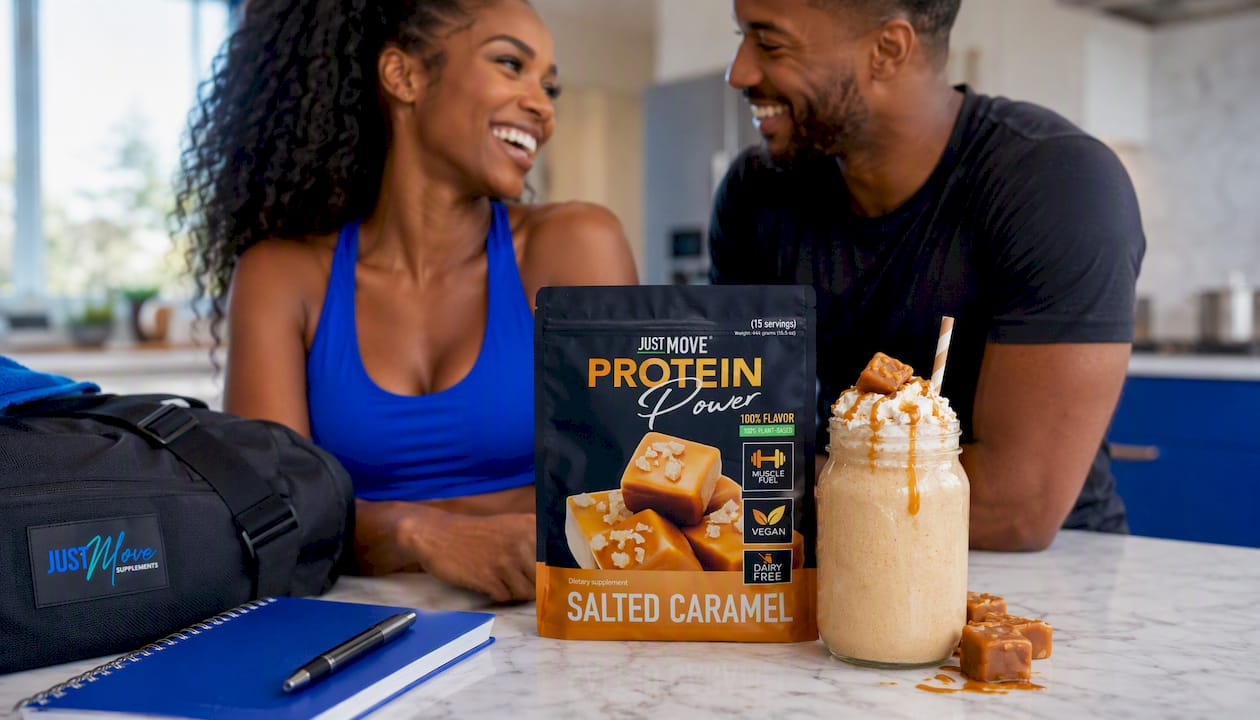
The Salted Caramel Protein is a standout option for anyone looking to cover their post-workout protein and amino acid needs with a flavor that doesn’t feel like a chore. It pairs naturally with an EAA powder for a complete peri-workout protocol: EAAs before or during training, Salted Caramel Protein after. The formula is crafted with quality and taste in mind, backed by Justmovesupplements’ commitment to customer satisfaction and positive community feedback.
✅ High-quality protein with a complete amino acid profile
✅ Exceptional flavor that makes post-workout nutrition something to look forward to
✅ Trusted by a community of fitness enthusiasts who prioritize both performance and taste
Check out the Salted Caramel Protein page to place your order and experience what a well-formulated recovery protein actually tastes like.
Useful sources
Recommended


